Contents
- Why does fashion depend on this document?
- Who actually produces one?
- Who reads it at the factory?
- How do conventions differ across the industry?
- Where does it sit in the development calendar?
- What does the industry get wrong about them?
- How is the practice changing?
- Does the spelling matter in the industry?
- How did this become the industry standard?
- What happens when the document fails?
- What does this mean for a small brand?
- Working with GarmentSpec
- Frequently asked questions

Fashion is unusual among manufacturing industries in that the people who design a product almost never make it, rarely visit the place it is made, and frequently work in a different country and language from the people producing it. The techpack exists to close that gap. It is the one document that travels the whole distance between a design decision and a cut piece of cloth.
This covers who produces one, who reads it, how the conventions differ across the industry, how the practice became standard, and why fashion specifically cannot operate without them. If you are new to the document itself, start with what a tech pack is.
Key Takeaways
- Fashion separates design from production almost completely. The techpack bridges it.
- Different people at a factory read different sections and rarely see the rest.
- Conventions vary by brand, retailer and region, but the content requirements do not.
- A specification travels further than any other document in the entire process.
- The industry runs on it because nothing else carries design intent across that distance.
Why does fashion depend on this document?
Because design and production are separated by distance, language, organisation and time, and nothing else crosses all four.
Designers rarely make anything
In almost every other manufacturing discipline the people specifying a product work in the same building, or at least the same country, as the people producing it. In apparel a design decision made in one country is routinely executed in another by people the designer will never meet or speak to, which means every assumption has to be written down explicitly or it simply does not survive the journey.
Language is a real constraint
Technical drawings, measurement tables and standardised terminology all work across languages in a way that descriptive prose simply does not. A well-built techpack is largely readable without translation by somebody who shares no language with its author, which is one of the main reasons the conventions of the document became as visual and as tabular as they are rather than narrative.
Production happens in parallel
A range is developed, quoted, sampled and produced across overlapping timelines, frequently with several different factories working simultaneously on different styles. The specification is what allows all of that to proceed without any single person needing to hold the entire picture in their head at once.
Nothing else travels the distance
Emails get lost or reach only one person, conversations are never shared beyond the two people having them, and physical samples circulate without any context attached explaining what about them is intentional. The techpack is the only artifact that reliably reaches everybody who needs it in a usable form, which is why the industry standardised on it rather than on anything richer or more flexible.
Who actually produces one?
Technical designers in larger businesses, the brand owner or a freelancer in smaller ones, and sometimes the factory itself.
In larger brands, a technical designer
Established businesses employ technical designers or product developers whose job is converting design intent into specification. It is a distinct role with distinct training, and its existence is the clearest signal of how much work the translation actually represents.
In smaller brands, whoever can
Small brands often have somebody who can design and nobody who can specify. In our experience that is one of the most common gaps in a young apparel business, and a frequent reason brands stall before they receive a usable quote. The work ends up done by a freelance tech pack designer, by a fixed-price service, or in a rush by the brand owner.
Sometimes the factory
Some full-package suppliers produce the specification themselves as part of their service, which is genuinely convenient and also means the resulting document reflects their conventions, their machinery and their commercial interests rather than yours. It frequently means you do not own the file either, which becomes important the moment you want to produce the same garment somewhere else.
Increasingly, a mix
A generated or templated structure, filled in by the brand, reviewed by a technical person and revised by a factory is now a common approach. It works when somebody competent checks it and fails quietly when nobody does.
Who reads it at the factory?
Four different people, each using one section and rarely seeing the others.
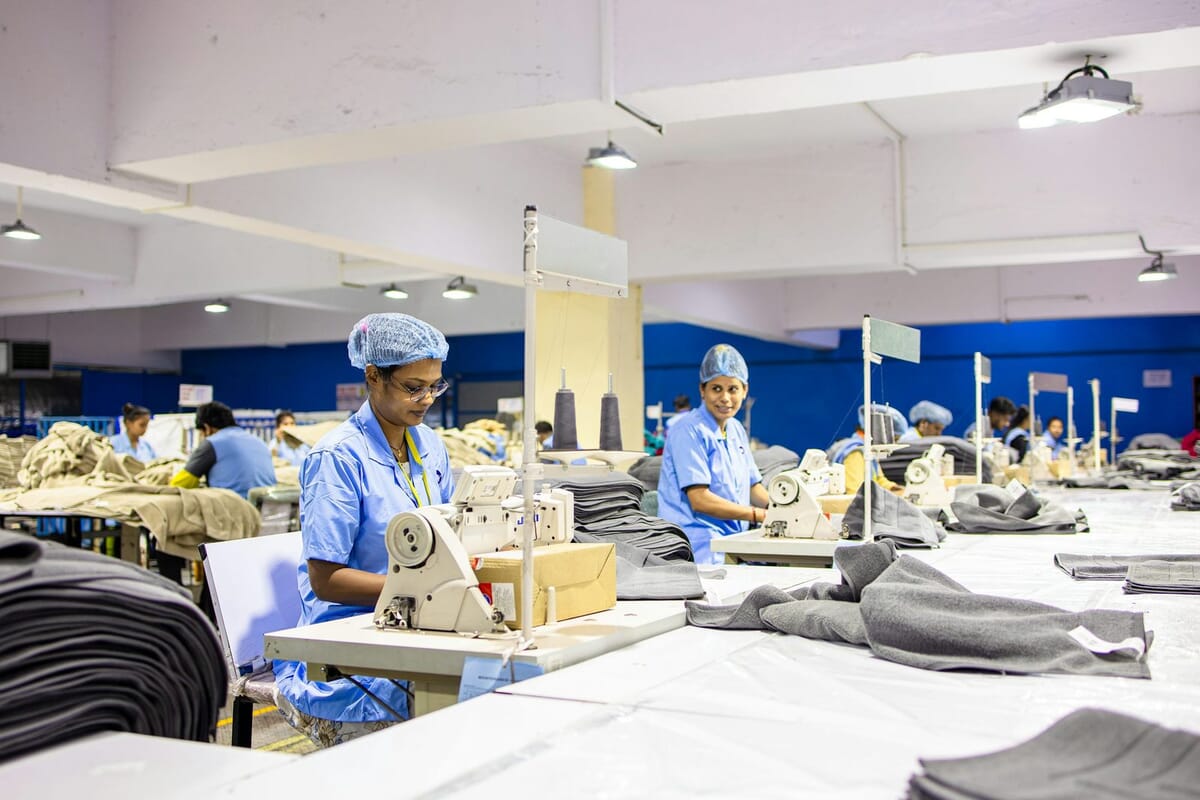
Costing reads the flats
The person pricing the garment counts operations from the technical flats and estimates fabric consumption. Anything they cannot count they either query, which costs time, or assume, which costs money when the assumption is corrected.
Purchasing reads the bill of materials
Components are ordered entirely from that one list, frequently by somebody who never opens the technical drawings at all and has no reason to. A trim named as a category rather than as a specification therefore gets bought as a category, no matter how precisely it happens to be drawn elsewhere in the same document.
The line reads construction and the sealed sample
Operators and supervisors work from construction notes and a physical approved garment. Anything written as an intention rather than a method effectively does not exist by the time production starts.
Quality control reads the measurements
Inspection happens against the listed points of measure and their stated tolerances and against nothing else whatsoever. A standard you care about that does not appear in that table will simply not be checked by anybody, and a garment missing it passes inspection entirely legitimately, which is how many delivery disputes start.
Short on time? We build the same spec as a service: technical flats, bill of materials, graded points of measure with tolerances. $299 per style, 3 to 5 working days.
How do conventions differ across the industry?
Layout and terminology vary considerably. The content requirements barely do.
Retailers impose their own formats
A brand selling into a large retailer is frequently required to submit its specifications in that retailer's own format, through that retailer's own system, to that retailer's timetable. That is a compliance requirement attached to the account rather than a preference anybody can negotiate, and the work involved belongs in the cost of serving the customer rather than being absorbed silently.
Regions use different terminology
Points of measure, grading conventions and construction terms differ between sourcing regions, and a specification that assumes one region's vocabulary can confuse a factory in another. Illustrating measurements on the flat removes most of this problem permanently.
Categories have their own norms
Knitwear, tailoring, denim and technical outerwear each carry their own conventions about what gets specified, in how much detail and in what order. A document written to the habits of one category can under-specify another quite badly, which is why a template borrowed from an unrelated product type is a poor starting point however complete it looks.
The requirements are constant
Whatever the format, whatever the region and whatever the retailer's system demands, a factory needs exactly three things: countable operations, specifically named components and measurable tolerances. Every convention and every proprietary template in the industry is ultimately a different way of presenting those same three requirements.
Where does it sit in the development calendar?
After fabric is settled, before quoting, and it gets revised once a sample exists.
Fabric comes first
Drape determines silhouette and shrinkage determines measurements, so a specification written before the fabric is chosen will need revising once it is. In our experience this sequencing error is a common reason a development cycle has to repeat.
It unlocks quoting
Factories cannot price an idea because they cannot count operations. The specification is what converts an enquiry into a quote, which is why brands without one often find that factories do not respond.
Sampling tests it
A specification remains a theory until a physical garment exists to test it against. The fit sample proves whether the pattern works on a body, the pre-production sample proves whether the factory can build what was approved, and both stages often produce refinements that belong back in the document rather than in somebody's memory.
It becomes the reorder reference
Once a production run has gone through successfully, the specification together with the sealed sample is what makes a repeat order identical to the first one rather than approximately similar to it. That is the point at which the document stops being a development cost and becomes the thing actively protecting your product, and it keeps doing that for as long as you sell the style.
What does the industry get wrong about them?
Treating them as paperwork, as a design artifact, or as something to produce after choosing a factory.
They are not paperwork
A techpack is the instruction set for manufacturing rather than an administrative requirement. Brands that treat it as a formality produce documents that satisfy nobody and then experience the consequences as factory problems.
They are not a design document
A techpack is read exclusively by people whose job is building things rather than evaluating them. Illustrations, mood references and styling language belong in a different document entirely, and including them in place of technical content is, in our experience, a common reason a first enquiry to a factory goes unanswered rather than declined.
They should not wait for the factory
Brands frequently spend months looking for a manufacturer and only then start producing a specification, which means every early conversation they have cannot actually be priced and every quote they eventually receive is incomparable with the others. The document should exist before the outreach begins rather than being assembled in response to it.
Cheap versions are not cheaper
A specification that a factory returns with a list of questions costs the brand calendar time, a second round of quoting and a measurable amount of credibility with that supplier. The saving made on the document itself is often smaller than the cost of those three things combined, and it is a calculation worth doing before committing.
How is the practice changing?
Tooling has made drafting faster; none of it has touched the judgement.
Structure has become cheap
Templates, dedicated software and AI generators all now produce a complete and correctly labelled document structure within minutes, which genuinely removes the risk of omitting an entire section and materially lowers the barrier for a first-time brand that has never seen a specification before.
Judgement has not
Grading, tolerances and fabric allowances are decisions about bodies and materials rather than formatting tasks, and no tool has made them easier. Because everything around them is faster, they are now a larger proportion of the remaining work.
The gap is more visible
Brands can now produce something that looks like a specification in an afternoon, which means the difference between a document and a usable document matters more than it used to rather than less.
Factories have adapted
Production managers who have received several confident documents with unusable measurements ask more questions than they once did. That scrutiny is reasonable and it falls on brands whose documents cannot answer it.
Does the spelling matter in the industry?
No. Both forms are in normal professional use.
Techpack and tech pack are interchangeable
Brands, factories, freelancers and software all use both, and nobody in the supply chain will misunderstand either. Some regions and some businesses favour one, and neither is more correct.
Search behaves differently
The two spellings function as separate queries, so guidance, tools and freelancers surfaced by one are not the same set as the other. This is a practical difference when researching rather than a professional one.
The contents are the standard
Whatever it is called, a techpack in fashion means technical flats, a bill of materials, construction detail and graded measurements with tolerances. Anything described as one without graded measurements is less than the term implies.
Ask for the section list
Given how loosely the word travels, requesting the list of included sections is the only reliable way to know what a supplier means by it. This holds for freelancers, tools and factories alike.
How did this become the industry standard?
Offshoring separated design from production, and the document filled the gap that separation created.
Proximity used to do this work
When garments were made near where they were designed, a great deal of specification happened through conversation, shared reference and somebody walking onto a floor to look. None of that survived the move to distant sourcing, and the techpack is what replaced it rather than an improvement on it.
Volume made ambiguity expensive
At a few hundred units a misunderstanding is a costly correction; at tens of thousands it is a disaster. As order sizes grew the tolerance for unwritten assumptions collapsed, which pushed the industry toward documenting things that were previously understood.
Retailers standardised the requirements
Large buyers imposing consistent submission formats across many suppliers did much of the work of establishing what a specification contains. Brands selling into those accounts adopted the conventions, and the conventions then spread to brands that never sold wholesale at all.
The format has proved durable
Flats, a materials list, construction notes and a measurement table have survived several decades, multiple sourcing shifts and the arrival of digital tooling. That durability suggests the structure reflects what production genuinely needs rather than an arbitrary convention.
What happens when the document fails?
The cost lands in production rather than in development, which is why it is so much larger.
Questions before quoting
The mildest failure is a factory unable to price the garment without a round of clarification. It costs days of calendar and some credibility, and on a tight season those days come out of production rather than out of slack that does not exist.
Wrong sample, repeated rounds
A specification that can be read but not read unambiguously produces a sample that is nobody's fault and satisfies nobody. Each additional round costs a sample, shipping and calendar time, which is how a development cycle consumes a season.
Wrong production
The expensive failure is a document complete enough to be produced from and wrong in its grading or its measurements. Nothing prompts a question, the factory builds faithfully, and the error is reproduced across every unit in the order.
The relationship cost is real
Factories allocate attention to customers who make work straightforward. A brand that repeatedly sends documents requiring interpretation gets slower responses and less flexibility on its next order, which never appears as a line item anywhere.
What does this mean for a small brand?
The same document is required, at a different scale and without the staff larger brands have.
The requirements do not scale down
A factory producing two hundred units needs exactly the same information as one producing twenty thousand: countable operations, named components, measurable tolerances. Small brands sometimes assume a smaller order justifies a lighter document, and factories do not work that way.
The role usually does not exist
Larger businesses employ somebody whose entire job is this translation. A small brand often has the design intent and no technical designer, which in our experience is one of the most common gaps in a young apparel business.
Buying the role is normal
Contracting the specification, as a freelancer engagement or a fixed-price service, is ordinary practice rather than an admission of inadequacy. It is also usually faster and cheaper than approximating the work badly and then paying for the consequences.
The output compounds
Unlike most early costs, a specification is reusable: adapted for a second colourway, extended into a variant, sent to a different factory. It is one of the few things a small brand buys early that keeps returning value rather than being consumed.
Working with GarmentSpec
We build the document the industry actually runs on: technical flats, bill of materials, and graded points of measure with tolerances, in the layout factories read before cutting.
$299 per style ($249 per style for three or more), 3 to 5 working days, 2 to 3 revision rounds. Prefer to write it yourself? See how to make a tech pack, or what a tech pack costs from each type of supplier.
Frequently asked questions
What is a tech pack in fashion?
The specification document that carries a garment from design intent to production: technical flats, a bill of materials, construction detail and graded points of measure with tolerances. It is the one artifact that travels the whole distance between designer and factory.
Why does the fashion industry rely on tech packs?
Because design and production are separated by distance, language, organisation and time. Nothing else crosses all four reliably, which is why the conventions became visual and tabular rather than descriptive.
Who writes a tech pack?
Technical designers in larger businesses, and in smaller ones a freelancer, a service or the brand owner. Some full-package factories produce it themselves, which is convenient and means you may not own the document.
Who reads it at the factory?
Four different people: costing reads the flats, purchasing reads the bill of materials, the production line reads construction notes and the sealed sample, and quality control reads the measurement chart. Most of them never see the other sections.
Do tech pack formats differ between companies?
Layout and terminology vary considerably, particularly where a retailer imposes its own system. The content requirements barely vary at all, because every factory needs countable operations, named components and measurable tolerances.
When should a tech pack be produced?
After fabric is settled and before approaching factories. It is what converts an enquiry into a quote, so producing it after choosing a supplier means early conversations cannot be priced properly.
We build the factory-ready spec a manufacturer can quote from without a single question: technical flats, bill of materials, graded points of measure with tolerances, colorways and construction notes. $299 per style, 3 to 5 working days, 2 to 3 revision rounds.
Get your tech pack, $299Start with the free templateWe don't take your production. The spec is yours to send to any factory, anywhere. Talk to us first if you're not sure what you need.
GarmentSpec builds factory-ready tech packs: technical flats, bill of materials, and graded points of measure with tolerances. $299 per style, 3 to 5 working days.