Contents
- What is a tech pack, exactly?
- What goes in a tech pack?
- Where does the tech pack sit in the pre-prod…
- Why factories won't start without one
- Why did your factory reject yours?
- Who actually uses your tech pack?
- What's the difference between a tech pack an…
- Digital, PDF or spreadsheet: which tech pack…
- What does a tech pack cost?
- Tech pack glossary: the terms your factory w…
- Frequently asked questions
- The short version
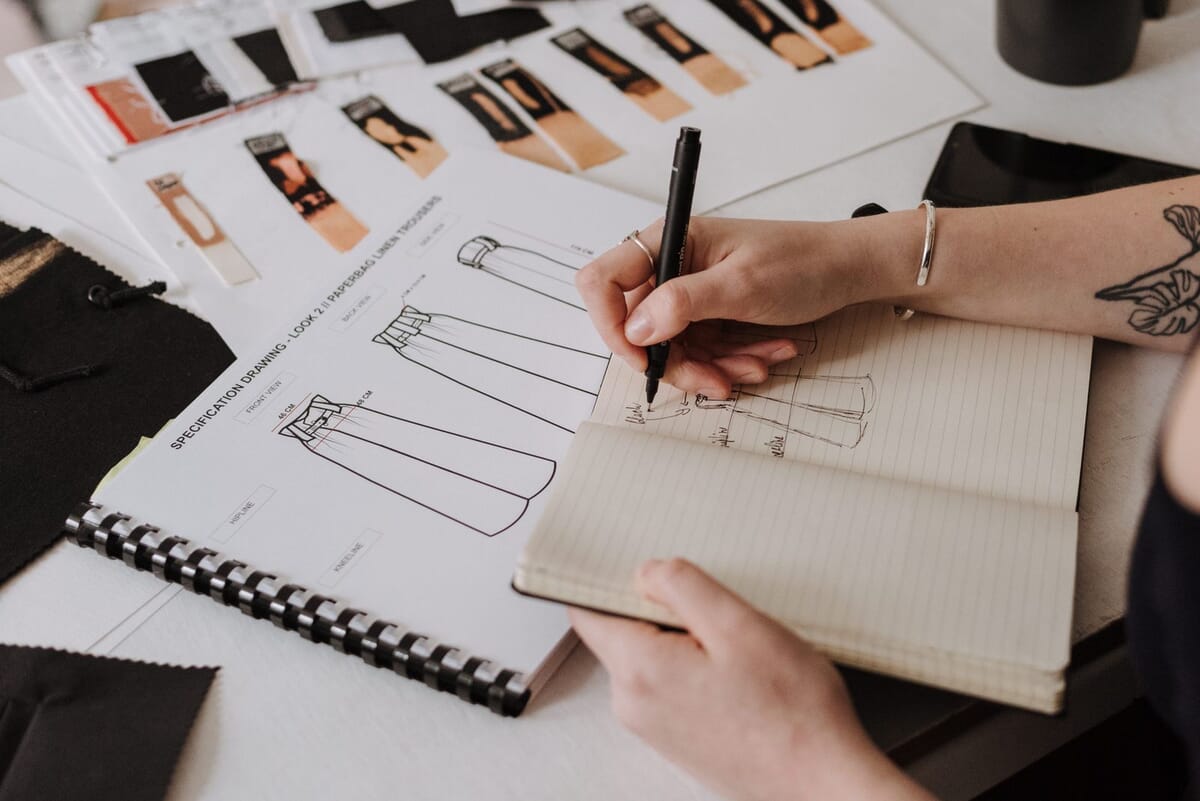
A tech pack is a document that outlines all the design and technical specifications of a garment. It contains flat sketches, a bill of materials, measurement specifications, size gradings, colorways, construction notes and a cost sheet. Factories use it as the single set of instructions for cutting, sewing and inspecting production.
That's the definition most of the industry works from. But a definition doesn't explain why a factory sends yours back. I lead technical development for the brands GarmentSpec works with. I've watched production managers slide a printed tech pack across a table, tap one empty cell with a pen, and say nothing. The document was pretty. It just couldn't be built from.
Key Takeaways
- A tech pack is the technical spec sheet a factory builds your garment from: sketches, bill of materials, measurements, gradings, colorways, construction notes.
- Professional designers charge $500 to $2,000 to prepare a standard tech pack (Guru, 2022).
- Factories reject tech packs for missing measurement points, vague materials and absent grading rules, not for bad art.
- A tech pack is not a pattern. Different document, different job.
This page answers the definition. If you want the full walkthrough, read the complete tech pack guide.
What is a tech pack, exactly?
A tech pack is a document containing all the technical information about your product (Sewport). It's not a mood board and it's not a design portfolio. It's a build spec. Every measurement, material, stitch type and label position a factory needs to produce your garment without calling you lives inside it.
Think of it as the contract between your idea and a sewing machine. The designer owns the intent. The factory owns the execution. The tech pack is the only place those two things meet, and anything that isn't written in it gets decided by someone in the cutting room who has never met you.
Two words on naming. Some people say technical package. Some say spec sheet. The industry standard term, the one your factory will use in an email, is tech pack. Use it consistently and everyone stays aligned.
In our experience, brands who send a tech pack get quoted in two days. Brands who send a Pinterest board and a photo of a hoodie they like get quoted in two weeks, if at all, and the quote is padded because the factory is pricing its own uncertainty.
If you want to see what one actually looks like, our free factory-tested tech pack template is the same structure factories accept.
What goes in a tech pack?
A standard tech pack has eight components: flat sketches, bill of materials, garment measurement specifications, cost sheet, size gradings, colorways, construction notes and revision history. Sewport's list overlaps closely, adding fit logs and sample feedback. Miss one section and the factory has to guess.
Flat sketches
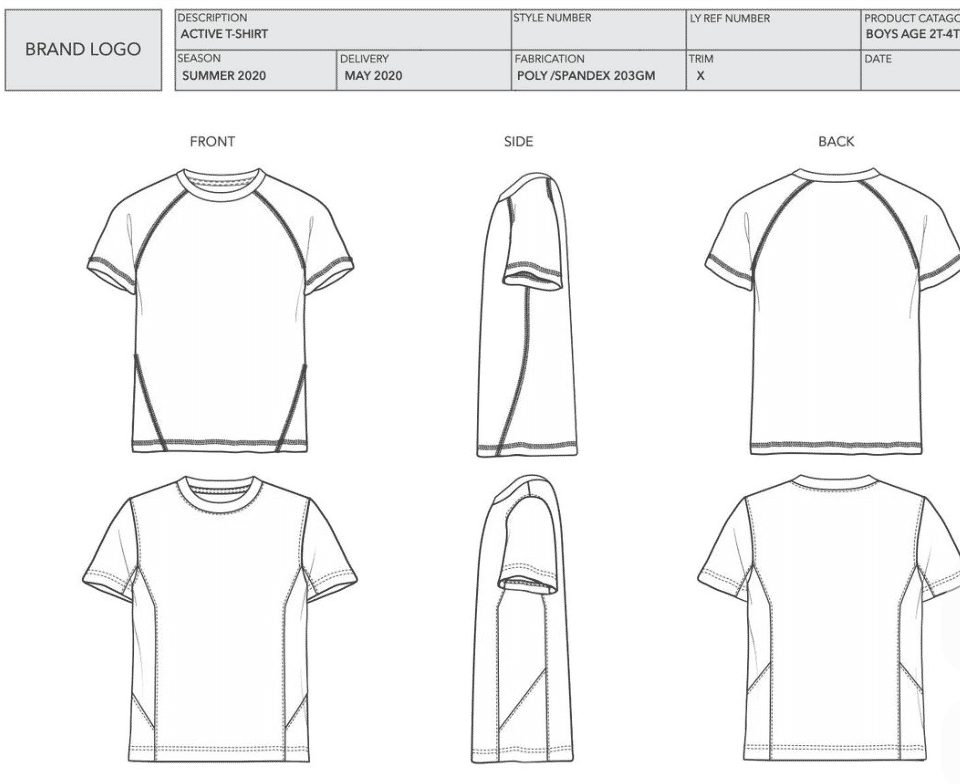
Flat sketches are 2D technical drawings of the garment, drawn as if it's laid flat on a table rather than worn on a body. They show the front and the back, and often a side or an inside view. Callout lines point from each seam, pocket, zip and topstitch row to the note that governs it. The factory reads the flats first to grasp the shape, then uses them as the map every other section hangs off. A vague or bodiced illustration here forces the pattern room to interpret, and interpretation is where your first sample drifts from your idea. For the drawing conventions factories expect, see our fashion flat sketch rules.
The bill of materials
The bill of materials, or BOM, lists every physical component in the garment. Not "cotton." A composition, a weight in GSM, a supplier, a colour reference, a quantity per unit. Sewport counts embroideries, prints, labels, buttons, tags, threads, trims and fastenings as separate BOM lines, and every one of them has a lead time attached.
Measurement specifications
Measurement specs are a table of points of measure with a target value and a tolerance, usually in centimetres. Chest at 2.5 cm below armhole. Sleeve length from centre back. Hem sweep. The tolerance column matters as much as the target, because it defines what counts as a defect.
The cost sheet
The cost sheet breaks the garment into fabric, trims, labour and overhead, then lands on a per-unit cost at a stated order quantity. It matters because it forces both sides to agree on what's included before bulk. When a factory sees your target cost early, it can flag a trim you can't afford at your quantity, or a fabric that only prices well at three times your order. The cost sheet is also where a designer discovers that the contrast lining they love adds two dollars a unit. Better to learn that on paper than after a 500-unit run.
Size gradings
Size gradings are the rules that scale your base size up and down the range. Each point of measure gets a grade rule: how many millimetres the chest grows from S to M, from M to L. Feed the factory a graded spec and every size in the run belongs to the same garment. Leave it out and the factory either invents the increments or borrows a standard table that isn't your fit. Your S and your XL then end up looking like they came from two different brands.
Colorways
Colorways define every colour a style ships in, each one tied to a physical standard: usually a Pantone TCX reference or an approved lab dip. "Navy" is not a spec. A factory dyeing to a loose word and a factory dyeing to Pantone 19-4025 TCX produce two visibly different blues. The colorway page is what makes your reorder match your first run six months later. It's also what stops a five-colour drop arriving as five slightly-off versions of the same murky tone.
Construction notes
Construction notes tell the factory how the garment is assembled: seam types, stitch density, overlock versus coverstitch, topstitch distance from edge, label placement in millimetres. This is the section beginners skip. It's also the section that decides whether your sample looks like a $20 garment or a $120 one.
Revision history
Revision history is the dated log of every change, with a version number on the cover page. It sounds like bureaucracy until a factory cuts 500 units from version 2 while you're approving version 4. The version number is the single field that stops that. It's also the one brands most often leave blank. Every fit comment, every swapped trim, every tolerance you tighten should bump the number and get a line in the log, so anyone opening the file knows instantly whether they're holding the current spec or an old one.
Where does the tech pack sit in the pre-production workflow?
Your tech pack is the first gate in a chain of roughly six. Production never jumps from spec to bulk. It moves through costing, a counter-sample, a fit sample, grading and a pre-production sample, and the final gate is an AQL inspection that accepts or rejects the shipment against your tolerances (QIMA). Every gate reads back to the same document. The stages that come before the tech pack, from fabric choice to sampling, are covered in our guide to fashion product development.
Here's the chain in order. The tech pack goes out first, and the factory prices from it: that's the costing and quote gate. Next comes the counter-sample, sometimes called the proto or first sample, a single unit the factory sews to prove it read your spec correctly. Then the fit sample, tried on a fit model or a dress form and measured point by point against your table. Comments from that session don't get texted around. They get written back into the tech pack as a new revision.
After the fit is signed off, grading scales the approved base size across the whole run using your grade rules. Then the pre-production sample, the PP sample, is sewn in the real bulk fabric and real trims. It becomes the gold-seal reference: the physical garment every finished unit gets checked against. Only then does bulk run, and only then does the AQL inspection close the loop.
The pattern we see over and over: brands treat the tech pack as a one-time document and the samples as separate events. They aren't separate. A fit comment that never makes it back into the spec is a fit comment the factory forgets by the PP sample. In our experience, the brands with clean production are the ones whose tech pack grows a revision after every single gate, so the PP sample and the document say the same thing.
Why factories won't start without one
Factories require a tech pack because production is a statistical process with an accept-or-reject gate at the end. Garment inspection runs on sampling standards like ISO 2859-1 and ANSI/ASQ Z1.4, where an inspector checks a sample and accepts or rejects the entire shipment against a defined defect limit. Without a spec, nobody can define "defect."
That's the mechanism people miss. A factory isn't asking for a tech pack to be difficult. It's asking because the quality inspector, who is often employed by your buyer and not by the factory, will show up with a checklist and compare finished garments against written tolerances. If the tolerances don't exist, the inspection has no baseline, and the factory carries a risk it didn't price. Before you send it, run it through our tech pack checker.
Here's the part nobody tells new brands: your tech pack is not primarily a communication tool. It's a liability document. It decides who pays when 500 units come out 2 cm short. Written spec, factory pays. No written spec, you pay. That asymmetry explains almost every "annoying" question a factory asks you.
In practice, the rejections cluster around three gaps: measurements with no tolerance, materials named with no composition or weight, and a size run with no grading rule. None is a design flaw. Each one stops a cutting table until someone fills it in, which is why the questions come back before the quote does.

Why did your factory reject yours?
Factories reject tech packs for gaps, not for taste. The common ones: a point of measure with no tolerance, a BOM line that says "cotton" with no composition or GSM, no grading rule between sizes, and no revision number, so nobody knows which version is live. None of these are design problems. All of them stop a cutting table. We catalogue the most common tech pack mistakes that trigger these rejections, with the fix for each.
Take a missing point of measure. The factory has three options, and every one of them costs you. It can stop and email you, which burns three days. It can guess from the sketch, which means your sample comes back wrong and you blame them. Or it can copy the measurement from a similar garment it made for someone else, which is what actually happens more often than anyone admits.
Missing grading rules are worse. If your spec gives measurements for size M only, the factory has to invent the size range. Standard body measurement tables exist for exactly this: ASTM D5585-21 covers adult female misses sizes 00 to 20, maintained by ASTM Subcommittee D13.55. But a standard table is not your brand's fit. Let the factory pick, and your S and XL belong to a different label than your M.
The seven cells factories send back
Rejections aren't random. Across the tech packs we review they land on seven recurring gaps, and each one stops a specific machine. Learn the seven and you can pre-empt almost every "quick question" email a factory sends before it quotes.
No point of measure or no tolerance is the biggest one. Without a tolerance column, the cutting room can't tell a defect from a normal unit, so the inspection has no baseline. No seam allowance or stitch type is next: the pattern room has to guess how the pieces join, and a coverstitch hem sewn as a single needle looks cheap and blows out in the wash. Missing BOM placements, a button with no coordinate, a label with no position, force the line to place trims by eye, and no two operators place them the same.
Then the structural gaps. No grading rule means the factory invents your size range. No colorway or Pantone reference means the dye house free-styles your brand colour. Ambiguous units, a spec that mixes centimetres and inches or lists "36" with no unit at all, produce a garment built to the wrong number. And no revision control means nobody can prove which version is live, so the factory cuts whatever it opened last.
Those weightings come from our own network, not a published study, and I'd caution against reading the exact percentages too literally. The ranking is what holds. Measurement and material gaps swamp everything else, and the "boring" section, revision control, sits at the bottom by frequency yet causes the most expensive single failure when it does hit, because it wastes whole cut runs rather than single samples.
What "rejected" means on an inspection line
Rejection isn't a mood. It's an AQL threshold. AQL 2.5 is the most common standard for general consumer goods, AQL 1.0 is used for higher-risk categories, AQL 4.0 applies where minor cosmetic defects are acceptable, and critical defects sit at AQL 0 (QIMA). Your tech pack tolerances feed straight into that gate.
The stakes are not abstract. US retail returns hit $890 billion in 2024, and 76% of consumers say free returns shape where they shop (NRF, 2024). Fit complaints ride that wave. A garment that sits outside spec doesn't just fail inspection. It comes back from the customer months later.
Garment type changes which measurements matter most. A hoodie lives or dies on hood height and pouch placement, which is why we spec it separately in the hoodie tech pack guide.
Who actually uses your tech pack?
Four different people read your tech pack, and each pulls out only the fields their job needs. Sewport frames the document as carrying all the technical information about a product (Sewport), but nobody reads the whole thing cover to cover. The designer reads intent, the factory reads build, the inspector reads tolerances, the agent reads sourcing.
The brand or technical designer owns the document. They write it, they revise it after every fit session, and they hold the version number. On the factory side, the reading splits again: the merchandiser reads the BOM to source fabric and trims, the pattern room reads the flats and the point-of-measure table to draft, and the sewing line reads the construction notes to assemble. One document, three internal audiences.
Then the quality inspector, who is often hired by the buyer rather than the factory, reads almost nothing but the measurement table, the tolerances and the AQL. That's their entire universe on inspection day. A sourcing agent, if you use one, reads the BOM and the cost sheet to place and consolidate orders. So a single empty cell doesn't inconvenience one person. It stalls whichever of these four hits it first, and they hit different cells.
This is why "make it clearer" is the wrong instruction to yourself. A tech pack isn't unclear or clear as a whole. It's complete or incomplete per reader. Your flats can be gorgeous and your BOM still blocks the merchandiser. Write for the four readers separately and the rejections mostly disappear.
What's the difference between a tech pack and a pattern?
A tech pack is the specification. A pattern is the solution. The tech pack says the finished chest must measure 56 cm with a 1 cm tolerance. The pattern is the set of shaped pieces a patternmaker drafts to achieve that, accounting for seam allowance, fabric shrinkage and stretch recovery. You need both. They are not interchangeable.
| Tech pack | Pattern | |
|---|---|---|
| What it is | The specification | The solution that hits the spec |
| Contains | Measurements, tolerances, BOM, grading, construction | Shaped pieces with seam allowance |
| Versioned? | Yes, revised after every fit session | Cut once |
| Who makes it | Designer / technical designer | Patternmaker (often the factory) |
Brands confuse these constantly, and the confusion is expensive. Sending a factory "the pattern" without a tech pack gives it shapes with no tolerances, no BOM and no grading logic. Sending a tech pack without a pattern is normal and fine: most factories will draft the pattern themselves, or you hire a patternmaker, and the tech pack tells them what to hit.
One more distinction. A tech pack is versioned. Revision history is a standard section for a reason. Patterns get cut once. Tech packs get revised after every fit session, and the revision number on the cover page is what stops a factory cutting 500 units from version 2 while you're approving version 4. For the full side-by-side, see tech pack vs pattern.
Digital, PDF or spreadsheet: which tech pack format?
Format matters less than completeness, but it changes how fast revisions move and how easily version 4 gets confused with version 2. Freelance tech-pack work on design marketplaces runs roughly $50 to $150 an hour (Cad Crowd, observed range, not a benchmark), and part of that spread is the tool. Three formats dominate, and each handles version control differently.
A spreadsheet is where most first tech packs are born. It's free, flexible and every founder already knows it, but it handles images badly and drifts into version chaos the moment two people edit it. A PDF, exported from a template or a design tool, travels best between email inboxes and is what most factories actually want to receive. Its weakness is that it's static: every change means a fresh export, and stale PDFs multiply fast.
Dedicated PLM tools sit at the other end. They give you live revision control, linked BOM libraries and side-by-side sample logs, at the cost of a learning curve and a subscription. AI tech pack generators are newer still: vendors such as Adstronaut (an AI tooling company, disclosed as such) auto-draft a v1 from a sketch in minutes. They're genuinely useful for a first pass, but a human still has to set the tolerances, grade rules and colour standards, because those are judgement calls, not fills.
| Format | Best for | Weak spot |
|---|---|---|
| Spreadsheet | Building a first draft cheaply | Poor image handling, version drift |
| Sending to a factory | Static: every edit is a re-export | |
| PLM tool | Ongoing revision control | Learning curve and subscription cost |
| AI generator | Drafting a v1 fast | Still needs human tolerances and grading |
Whatever the tool, export a clean, versioned PDF to actually send. The factory doesn't care which app you drew it in. It cares that the revision number on the cover is unmistakable.
What does a tech pack cost?
Professional fashion designers charge between $500 and $2,000 to prepare a standard tech pack, and the work typically takes between five and twenty hours (Guru, 2022). The spread is mostly complexity. A tee is a few hours. A lined outerwear piece with twelve trim components is a different animal entirely. We break the real 2026 rates down by route in the tech pack cost guide.
Doing it yourself is legitimate, and plenty of good brands started that way. The cost then is your time plus the cost of the mistakes you make in version 1, which usually show up as a wrong sample and a lost month. That's the real trade. Money now, or calendar later.
The brands that get this right tend to build their first tech pack from a working template, send it to a factory for comment before ordering anything, and treat the factory's red pen as free consulting. It is free consulting. Most people ignore it.
Start there. Download the free tech pack template, fill in what you know, and let a factory tell you what's missing.
If you'd rather not spend twenty hours learning point-of-measure conventions, we build production-ready tech packs from your sketches for $299. See the tech pack service. If what you actually need is a manufacturer, or you're starting a clothing brand from zero, that's a different problem from writing the spec.
Tech pack glossary: the terms your factory will use
Most of a production conversation runs on six or seven acronyms. Two of them sit on published body-measurement standards: ASTM maintains dedicated size tables like ASTM D6960 for plus-size women, which is where grade rules and points of measure come from. Learn these and a factory email stops reading like code.
| Term | What it means |
|---|---|
| POM (point of measure) | A defined location where the garment is measured, such as chest 2.5 cm below the armhole. Each POM carries a target and a tolerance. |
| BOM (bill of materials) | The itemised list of every material and component in the garment, with composition, weight, colour and quantity per unit. |
| HPS (high point shoulder) | The top of the shoulder at the neck seam. It's the origin point most vertical measurements, like body length, are taken from. |
| AQL (acceptable quality limit) | The maximum number of defects allowed in an inspection sample before the whole shipment is rejected. |
| Grade rule | The increment a single measurement changes between one size and the next, in millimetres. |
| Colorway | A specific colour a style is produced in, tied to a Pantone reference or an approved lab dip. |
| Lab dip | A small fabric swatch dyed to a target colour and approved before the factory bulk-dyes the run. |
| GSM (grams per square metre) | Fabric weight. It's how a factory knows whether your "jersey" is a light tee or a heavy sweatshirt. |
| PP sample (pre-production) | The final approved sample, sewn in bulk fabric and trims, that every finished unit is checked against. |
Frequently asked questions
What is a tech pack in simple terms?
A tech pack is a document that outlines all the design and technical specifications of a garment. It includes flat sketches, a bill of materials, measurements, size gradings, colorways and construction notes. Factories use it to cut, sew, cost and inspect your product without guessing.
What does tech pack mean in fashion?
Tech pack means technical package: the complete set of build instructions a fashion brand hands a factory. It defines every material, measurement, tolerance, stitch and label. Sewport describes it as the document containing all the technical information about your product (Sewport). Industry-wide, the working term is tech pack.
Do I really need a tech pack to manufacture clothing?
Yes, if you want a predictable result. Garment inspection runs on sampling standards such as ISO 2859-1 and ANSI/ASQ Z1.4, where finished units are accepted or rejected against defined tolerances. Without a tech pack, no tolerances exist, so nobody can prove a garment is wrong, including you.
How much does a tech pack cost?
Professional designers charge between $500 and $2,000 for a standard tech pack, and the work takes five to twenty hours (Guru, 2022). Complexity drives the range: a simple tee sits at the low end, while lined outerwear with many trims sits at the top.
Is a tech pack the same as a pattern?
No. A tech pack specifies the target: finished measurements, tolerances, materials, construction. A pattern is the set of drafted pieces that achieves that target, accounting for seam allowance and shrinkage. Factories usually draft the pattern from the tech pack. One is the requirement, the other is the solution.
What is a POM in a tech pack?
A POM, or point of measure, is a defined location where the garment is measured, such as chest 2.5 cm below the armhole or sleeve length from centre back. Each POM carries a target value and a tolerance. That tolerance is what an inspector uses to accept or reject a finished unit on the line.
What file format should a tech pack be in?
Most factories want a PDF, and a PDF exported from a spreadsheet or a PLM tool travels best between email inboxes. The format matters less than completeness. Build it wherever you like, but send a clean, versioned PDF so the revision number on the cover page is unmistakable to whoever opens it.
Who prepares a tech pack?
A technical designer or the brand founder usually prepares the tech pack, though many small brands write their first one from a template. Some factories help refine it, and AI tools can now draft a version 1 from a sketch. A human still sets the tolerances, grade rules and colour standards, because those are judgement calls.
The short version
A tech pack is the document a factory builds your garment from, and rejections almost never come from bad design. They come from empty cells: a point of measure with no tolerance, a BOM line that says "cotton," a size range with no grading rule. Fill those in and the factory stops guessing. Guessing is where your money goes.
Start with a complete spec, send it for comment before you order, and version it every time you change something. Professional tech packs run $500 to $2,000 (Guru, 2022), but the first one you write yourself teaches you more than either number suggests.
When you're ready to build one properly, work through the complete tech pack guide. It walks the whole document, section by section.
Peter Midea is GarmentSpec's technical lead for brand development.
We build the factory-ready spec a manufacturer can quote from without a single question: technical flats, bill of materials, graded points of measure with tolerances, colorways and construction notes. $299 per style, 3 to 5 working days, 2 to 3 revision rounds.
Get your tech pack — $299Start with the free templateWe don't take your production. The spec is yours to send to any factory, anywhere. Talk to us first if you're not sure what you need.
Sources
Every statistic and definition in this article traces to one of the following. Each is listed once here, and cited inline where it is used.
- Guru
- Pexels
- Sewport
- QIMA
- Pexels
- ASTM International
- ASTM International
- National Retail Federation
- Cad Crowd
- ASTM International