Contents
- Page one: the cover
- Page two: the technical flats
- Page three: the bill of materials
- Page four: construction detail
- Page five: graded measurements with tolerances
- Page six: labelling and care
- Page seven: packing
- How do you know the sample is complete?
- What does a real measurement page look like?
- How does the factory use these pages together?
- What separates a sample you can copy from on…
- What if you only have one page?
- Working with GarmentSpec
- Frequently asked questions

Most people searching for a sample tech pack want to see what one actually looks like before producing their own. This walks through the pages a working techpack contains, in the order a factory reads them, with what belongs on each and what goes wrong when it is missing.
Nothing here is theoretical. This is the layout a factory reads before cutting, the sections are ordered the way production people use them rather than the way a designer would present them, and the walkthrough includes what each page looks like in practice and who at the factory actually reads it.
Key Takeaways
- A working techpack is seven pages or sections, not a single sheet.
- Costing reads the flats, purchasing reads the bill of materials, QC reads the measurements.
- The measurement page with tolerances is the section most often left incomplete, in our experience.
- Every page should carry a version number and date.
- The test is whether a stranger could make it without asking you anything.
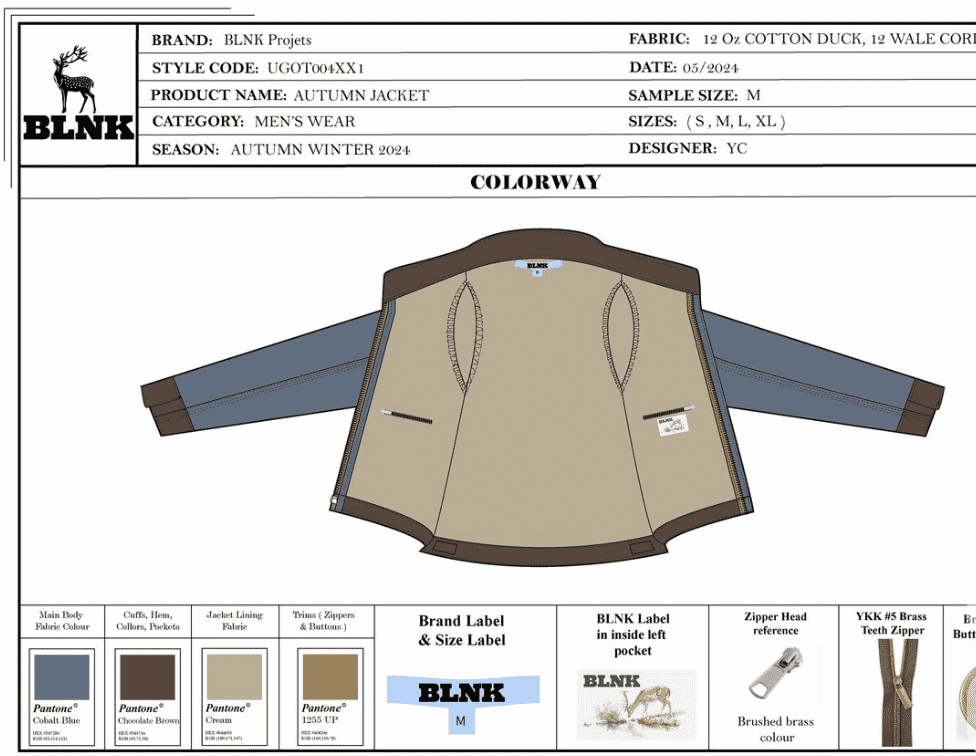
Page one: the cover
Identifies the style unambiguously and tells anybody picking it up what they are holding.
Style name, number and season
A factory handles many documents, and a specification that cannot be identified at a glance gets confused with another. Give the style a number as well as a name, because names change during development and numbers do not.
Version and date
One of the most useful items on a cover page, and one that is easy to leave out. A factory holding two copies of a document needs an immediate way of knowing which one governs, and a specification circulating without version markings is precisely how a production run ends up made to a measurement everybody had agreed to change three weeks earlier.
A rendered image or photograph
One image showing what the finished garment should look like, which orients everybody before they reach the technical content. This is a reference rather than an instruction and it should not be confused with the flats.
Contact and supplier detail
Who to ask when something is unclear, and which factory or supplier this copy was issued to. Specifications circulate, and knowing which version went where prevents a great deal of confusion later.
Page two: the technical flats
Proportional line drawings showing every seam, closure and construction line, front and back.
Drawn to proportion, not styled
A flat exists to communicate placement, so it has to be proportionally accurate. A stylised drawing with elongated proportions communicates mood and actively misleads about where a pocket sits, which is the opposite of what this page is for. Our guide to technical flats covers how to draw them.
Every construction line shown
Seams, darts, topstitching, closures, pocket openings and hems all appear, because each represents an operation somebody has to perform and count. An omitted line is an omitted cost and an omitted instruction.
Detail views at larger scale
Cuffs, collars, plackets, pocket bags, vents and anything unusual need enlarging to be legible at all, because at full-garment scale they resolve into a few ambiguous lines. This is where the actual construction of a garment gets communicated rather than merely indicated, and in our experience it is often missing from a first attempt at a specification.
It is what costing reads
The person pricing your garment counts operations from this page. Everything they cannot count they either assume or query, and an assumption made at costing becomes a price revision later.
Page three: the bill of materials
Every component with a specification, a quantity, a placement and a supply owner.
Named components, not categories
Button is a category; a four-hole 18-line corozo button in a stated colour with a named supplier reference is a component. Generic entries get filled with whatever happens to be convenient to source that week, and the substitution only surfaces when a sample arrives looking subtly cheaper than intended, at which point correcting it costs a revision round rather than a sentence.
Quantity and placement
How many, and where. The person attaching a label or a snap is working from this list rather than from the flats, which is why placement information belongs here as well as in the drawings.
Who supplies each line
A column stating explicitly whether you or the factory is sourcing each individual item, rather than a general statement at the top of the page. This column can change a quote substantially, and leaving it out is a common source of ambiguity: it is how you end up with two quotes that cannot be compared.
It is what purchasing reads
A different person orders components entirely from this list, frequently without seeing the flats at all. That is the specific reason a generic entry here cannot be rescued by a precise drawing elsewhere.
Page four: construction detail
Seam types, stitch density, seam allowances and how each edge is finished.
Specify the method, not the outcome
Clean finish, neat stitching and premium feel are all preferences rather than instructions, and nobody standing at a machine can act on any of them. A named seam type, a stitch count per inch and a stated seam allowance are instructions, they can be followed by somebody who has never met you, and they produce the same result on the first unit and the five hundredth.
Position by position
Different seams in the same garment warrant different constructions: a side seam, an armhole and a hem are not the same problem. Specifying per position rather than globally is what separates a considered document from a template.
Edge and hem finishing
How the front edge, hem, cuff and neckline are finished determines whether a garment looks resolved, and in an unlined garment the interior is visible whenever it is handled. These are visible quality decisions.
It is what the line reads
Operators and supervisors work from this section and the sealed sample rather than from the whole document. Notes that describe an intention rather than a method do not survive this stage.
Short on time? We build the same spec as a service: technical flats, bill of materials, graded points of measure with tolerances. $299 per style, 3 to 5 working days.
Page five: graded measurements with tolerances
Every point of measure, at every size, with an acceptable range against each.
Define how each point is measured
A point of measure that two competent people would measure differently produces a disagreement that is nobody's fault. Illustrating the method on the flat, or naming a convention the factory already uses, removes that ambiguity entirely.
Grade rather than scale
Bodies do not change proportionally between sizes, so uniform increments produce a garment that fits at the sample size and progressively worse toward both ends. Grading decisions belong here rather than being left to a factory's default rules. Our grading chart template shows one way to lay the increments out.
A tolerance on every point
Each measurement needs its own acceptable range, set tighter where the point is visible or structural and looser where a small variation genuinely will not be noticed by anybody. A chart without tolerances leaves quality control with nothing to inspect against, and it leaves you with no defensible basis for rejecting a delivery that misses, however unreasonable the miss feels.
State pre or post wash
Fabric shrinks, and a chart that does not say which state it describes is ambiguous exactly where it matters most. For anything laundered, give finished post-wash measurements and say so explicitly.
Page six: labelling and care
Every label, its content, its placement and the regulatory information it carries.
Main label and care label
The main label carries the brand and sits where the customer sees it. The care label carries fibre content and care instructions, and often the identity of the responsible company. These are legal requirements in many markets rather than branding decisions: in the US, the FTC requires most textile products to be labelled with fibre content, country of origin and the identity of the manufacturer or another responsible business, and a separate FTC rule requires care labels on clothing (FTC).
Placement and order
Where each label sits, in which seam, at what height, and in what order if several are stacked. Stacked care labels have an order and getting it wrong is visible on every unit.
Size labels vary by unit
Unlike the main label, size labels differ across the run, which makes them the component most likely to be miscounted or mixed. Break the requirement down by size explicitly.
Content has to be accurate
Fibre content stated incorrectly is a compliance problem as well as a trust problem, and care instructions have to suit the actual fabric. A garment that fails when a customer follows your own label is a self-inflicted return.
Page seven: packing
How finished garments are folded, bagged, cartoned and marked.
Folding and bagging
How the garment is folded, whether it is bagged, whether tissue or an insert is included. These are labour operations at the factory and they belong in the specification rather than being agreed verbally after a price is set.
Carton and labelling
How many units per carton, how cartons are marked and what documentation accompanies them. A warehouse receiving unmarked cartons cannot book stock in efficiently, which is a cost that lands after production.
Retail-ready requirements
Selling through retailers frequently means meeting a packing standard the retailer specifies rather than one you choose: particular folds, specified bag types, barcode size and placement, carton labelling. Obtaining that specification before production rather than after prevents a repack, which is expensive, slow and entirely avoidable if somebody asks early.
Added requirements change the price
Packing requirements added after a quote is agreed are a legitimate reason for a factory to revise it. Specifying them upfront keeps the number stable.
How do you know the sample is complete?
Hand it to somebody who has never seen the product and cannot ask you a question.
The stranger test
If they could produce the garment you intended from these pages alone, it is finished. If they would have to guess at anything, that guess will be made by somebody on a production floor applying their own conventions.
Walk the garment mentally
Go from cutting to packing and ask what a person would need to decide at each step. In our experience the decisions most often left open are seam finishes, label placement and packing, and all three are cheap to close.
Ask a factory to review it
Send it and ask whether they can quote it as it stands. Their questions are your defect list.
Expect one revision after sampling
Even a complete specification gets refined once a physical garment exists. Treat it as versioned rather than final, and make sure the factory is producing from the current version rather than the one first sent.
What does a real measurement page look like?
A table with one row per point of measure and one column per size, plus a tolerance column and a definition of each point.
Rows are points, columns are sizes
The conventional layout lists points of measure down the left, sizes across the top, and the measurement at each intersection. A tolerance column sits alongside, applying to that point across every size, because a tolerance is a property of the measurement rather than of the size.
The point list depends on the garment
A t-shirt needs perhaps eight to twelve points: chest, body length, shoulder, sleeve length, sleeve opening, neck width, neck drop and hem. A jacket needs considerably more, and a fitted dress more again. In our experience, listing too few is more common than listing too many. Our t-shirt tech pack guide shows a full set for a tee.
Each point needs a definition
Chest measured how, and from exactly where? Most specifications name the point and assume the method, which is how two careful people arrive at different numbers for the same garment. A small diagram on the flat showing each measurement line removes the problem permanently.
The tolerance reflects the point
Half a centimetre at the chest matters more than half a centimetre on a pocket position. Setting the range according to how visible and how structural each measurement is, rather than applying one figure across the table, is the difference between a chart that controls quality and one that merely records intentions.
How does the factory use these pages together?
Sequentially, by different people, each reading only the section relevant to their job.
Costing goes first
Before anything else happens, somebody prices the garment by counting operations from the flats and estimating fabric consumption. Anything ambiguous at this stage is either queried, which costs time, or assumed, which costs money when the assumption is corrected later.
Purchasing orders from the materials list
Components are sourced entirely from the bill of materials, frequently by a person who never opens the rest of the document. This is why a generically named trim gets generically filled regardless of how precisely it is drawn elsewhere.
The line builds from construction and the sealed sample
Operators work from construction notes and a physical approved garment rather than from a full specification. Anything expressed as an intention rather than a method effectively does not exist by the time production starts.
Quality control measures against the chart
Inspection happens against the points of measure and the tolerances, and nothing else. A standard you care about that does not appear in that table will not be checked, and a garment missing it passes legitimately.
What separates a sample you can copy from one you cannot?
Whether the numbers came from a real garment, and whether the document was ever produced from.
Many published samples were never made
Many example tech packs published online were made to illustrate a layout rather than to make a garment, so their measurements may never have been tested. Copying the structure is useful; copying the numbers is exactly the mistake that produces a factory making a generic product.
Look for tolerances as the tell
An example with a fully populated tolerance column, varying by point, was probably built by somebody who has had garments produced. One with blank tolerances, or a single repeated figure, was built to look like a techpack rather than to function as one.
Check whether construction is method or adjective
A sample specifying seam types, stitch densities and seam allowances per position is describing something buildable. One saying clean finish and neat topstitching throughout is describing an aspiration, and the distinction tells you how seriously to take the rest.
Use the layout, supply your own content
The right way to use any sample, including this walkthrough, is as a structure to populate from your own garment, your own fabric and your own fit sessions. The structure is genuinely transferable between products; nothing else in a techpack is.
What if you only have one page?
Then you have a spec sheet rather than a techpack, and it is worth knowing the difference.
A spec sheet is a subset
A single-page spec sheet typically carries a flat, a short materials list and a measurement table, which is enough for a simple garment being made by a factory that already knows you. It is a legitimate document and it is not the same thing as a techpack, and describing one as the other creates an expectation gap at exactly the wrong moment.
It works for repeat and simple product
Reordering a garment a factory has already produced, or specifying something genuinely simple like a basic tee for a supplier you have worked with for years, does not require seven sections. Sending more than the situation needs is its own kind of friction.
It fails for a new factory
A supplier who has never made anything for you has no context to fill gaps with, so every omission becomes either a question or an assumption. A first order with an unfamiliar factory is precisely where completeness matters most and where a spec sheet falls short.
Build the full version once
The economical approach is producing a complete techpack for a style once, then extracting a short spec sheet from it for reorders and familiar suppliers. That order works; starting with the short version and trying to expand it later does not, because the underlying decisions were never made.
Working with GarmentSpec
We build exactly this: technical flats, bill of materials, and graded points of measure with tolerances, in the layout factories read before cutting.
$299 per style, 3 to 5 working days.
Frequently asked questions
What pages does a tech pack contain?
Cover, technical flats, bill of materials, construction detail, graded measurements with tolerances, labelling and care, and packing. Different people at the factory read different sections, which is why each has to be complete on its own.
What is the most important page?
The graded measurement page with tolerances, because quality control inspects against it and nothing else. In our experience it is also the section most often left incomplete in self-made specifications.
Why do flats need to be proportional?
Because a factory reads placement from them and counts operations to produce a price. A stylised drawing with exaggerated proportions communicates mood and misleads about where components actually sit.
Does every measurement need a tolerance?
Yes. No production run hits a number exactly, so without a stated range a factory has no target to control against and you have no defensible basis for accepting or rejecting a delivery.
Should measurements be before or after washing?
For anything that will be laundered, give finished post-wash measurements and state that explicitly. A chart that does not say which it describes is ambiguous precisely where it matters.
How long is a typical tech pack?
Seven sections rather than a fixed page count, because a complex garment needs more detail views and construction notes than a simple one. Completeness matters; length does not.
We build the factory-ready spec a manufacturer can quote from without a single question: technical flats, bill of materials, graded points of measure with tolerances, colorways and construction notes. $299 per style, 3 to 5 working days, 2 to 3 revision rounds.
Get your tech pack, $299Start with the free templateWe don't take your production. The spec is yours to send to any factory, anywhere. Talk to us first if you're not sure what you need.
Sources
- FTC, Threading Your Way Through the Labeling Requirements Under the Textile and Wool Acts: fibre content, country of origin and responsible business on US textile labels; care labels under a separate FTC rule.
GarmentSpec builds factory-ready tech packs: technical flats, bill of materials, and graded points of measure with tolerances. $299 per style, 3 to 5 working days.