Contents
- What does a tech pack cost in 2026?
- Why is the tech pack price range so wide?
- What drives a tech pack's price up or down?
- What does the DIY route really cost?
- How much do freelancers and marketplaces cha…
- Do tech pack prices vary by region?
- What does a professional designer or agency…
- What about AI tech pack tools?
- What does an in-house designer cost?
- What does a worked cost comparison look like?
- Which route fits your garment?
- Where does $299 fit in all this?
- What hidden costs does a cheap tech pack cre…
- What's the real cost of getting a tech pack…
- Frequently asked questions
- The honest bottom line
Ask ten people what a tech pack costs and you'll get ten numbers. That's not a dodge. It's the actual market. Professional fashion designers charge between $500 and $2,000 to prepare a standard tech pack (Guru, 2022). Freelancers go lower. AI tools go lower still. A staff designer costs you a salary instead of a per-style fee. I've watched a production run get rejected because one measurement was missing from the spec, so I care less about the sticker price than about what each route actually buys you. This page maps every route, what it really costs, and why the range is so wide. Then I'll tell you where $299 sits in that picture. Want the format itself first? Start with what a tech pack is.
Key Takeaways
- Professional designers charge $500 to $2,000 per standard tech pack (Guru, 2022), driven by garment complexity and grading.
- Freelancers and marketplaces span a wide observed range; AI tools sell for a few dollars.
- A flat service like GarmentSpec runs $299 per style, sitting in the honest middle.
- The real cost isn't the tech pack. It's the rejected run when the spec is wrong.
What does a tech pack cost in 2026?
A standard tech pack costs between $500 and $2,000 when a professional designer builds it. That's the anchor number worth remembering. Around it sit cheaper and pricier routes: free DIY templates, freelancer gigs, AI generators, flat-fee services, and full in-house salaries. Same document, wildly different price tags.
Guru reports that professional fashion designers charge between $500 and $2,000 to prepare a standard tech pack, and that the work "can take between five and twenty hours" depending on the garment (Guru, 2022). That single spread explains most of the confusion buyers run into when they shop this out.
Why five routes and not one price? Because a tech pack isn't a product off a shelf. It's labor applied to your specific garment. A blank tee needs less of that labor than a lined, paneled, graded jacket. Every route below is really a different answer to one question: who does the labor, and how good are they?
Here's the same picture as a table you can scan. In-house sits apart because you pay a salary, not a per-style fee.
| Route | Cost per style | Source | Notes |
|---|---|---|---|
| DIY / free template | $0 tools, plus your time | GarmentSpec template | Real cost hides in a wrong first sample |
| Freelancer / marketplace | $100 to $2,000+ | Adstronaut (AI vendor) | Skill and clarity vary hugely |
| Professional designer | $500 to $2,000 | Guru (2022) | Five to twenty hours of work |
| Flat-fee service | $299 | GarmentSpec | One price, revisions included |
| In-house designer | $55,000 to $85,000 / year | Adstronaut (AI vendor) | Annual salary, not per style |
Why is the tech pack price range so wide?
The range is wide because a tech pack is labor, and the amount of labor swings with the garment. Guru pegs the work at five to twenty hours. A simple tee lands near the bottom. A graded, multi-panel jacket with linings and tolerances lands near the top. Complexity is the dial that moves the price.
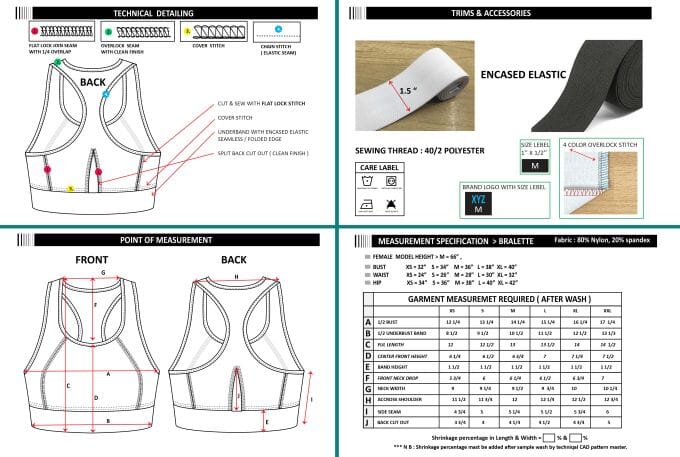
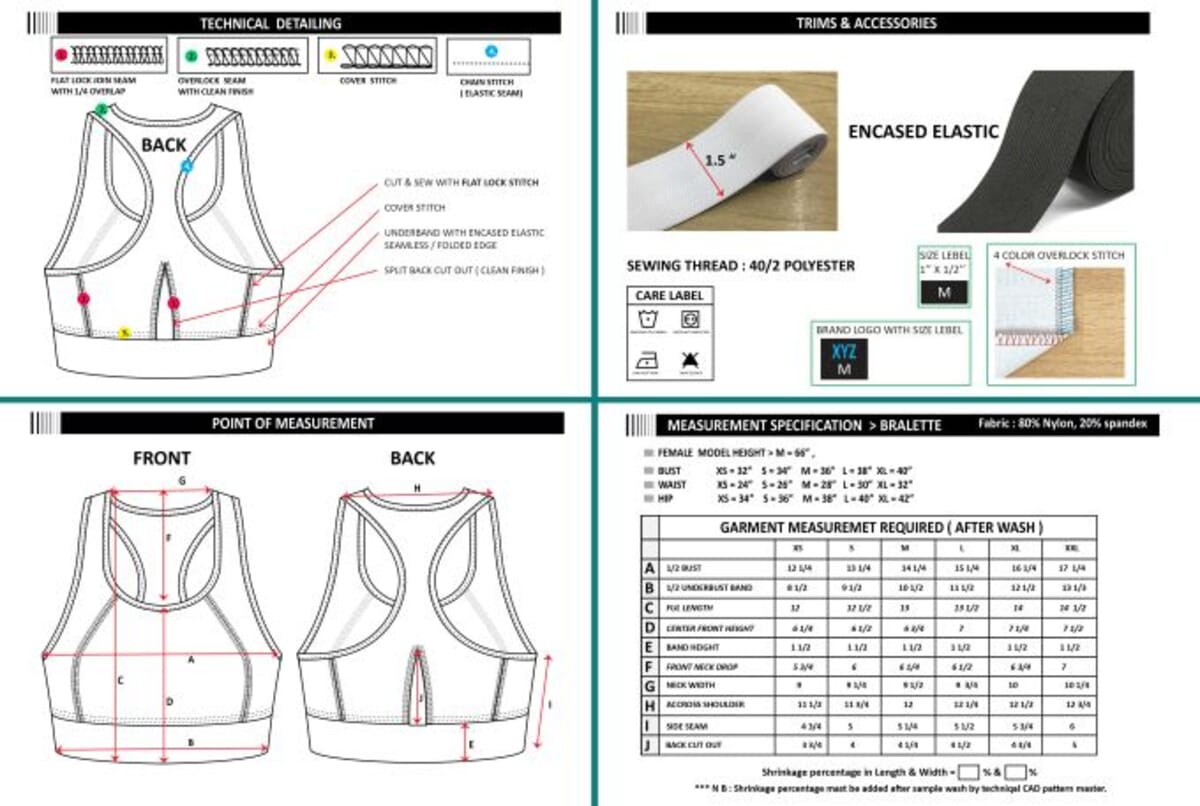
A standard tech pack carries roughly eight sections, from a bill of materials to construction details and a measurement chart, and the more of each a garment needs, the more hours it eats. Grading and tolerance work sit inside those hours, and they scale fast with garment complexity.
Four things drive the number. Complexity: pieces, seams, trims, linings. Revisions: every round adds hours. Grading: sizing a garment across a run is skilled, standardized work, governed by references like ASTM D5585-21 and maintained by Subcommittee D13.55. Tolerances: how much variance the factory may accept per measurement. Miss those, and you don't have a spec. You have a suggestion.
I've had a batch stall because a bill of materials listed "ribbing" with no gauge and no width. The factory guessed. The neckline came back wrong on all of it. That mistake cost more than any tech pack quote on this page, and it came from a document that looked finished. Cheap and complete are not the same thing.
What drives a tech pack's price up or down?
Five levers move a tech pack's price, and garment complexity leads them all. A standard tech pack carries roughly eight sections, from a bill of materials to construction and a measurement chart, and every section your garment actually needs adds billable hours. Fewer pieces, fewer hours. More panels, linings and trims, more money.
The price of a tech pack is really the price of hours, and four inputs decide how many: how complex the garment is, how many styles you commission at once, how deep the size grading goes, and how many revision rounds you run before sign-off. Change any one and the quote moves with it.
Garment complexity
Complexity is the biggest single driver. Count the parts: panels, seams, closures, linings, trims, print or embroidery placements. A jersey tee has a handful. A lined bomber with welt pockets, ribbed trims and a two-way zip has dozens, and each one needs a callout, a measurement and a tolerance. That's why the same document can take five hours or twenty (Guru, 2022).
How many styles you commission
Volume cuts the per-style price. A designer setting up one tech pack builds a template, a size table and a house style from scratch. The second garment in the same range reuses most of that scaffolding, so the marginal hours drop. Speccing a five-piece capsule? Ask for a batch rate. Most makers price a range below five separate one-offs.
How deep the grading goes
Grading is skilled, standardized work, and depth costs money. Sizing a garment across a full run follows measurement tables like ASTM D5585-21 and ASTM D6960, maintained by Subcommittee D13.55. A two-size sample grade is quick. A full XS-to-XXL grade with graded points on every measurement is not, and it belongs in the quote as its own line.
From scratch or from a reference garment
Speccing from a physical reference garment is almost always cheaper than speccing from a sketch. When you can hand a maker a sample to measure, pull apart and photograph, you delete hours of guesswork and back-and-forth. A flat drawing on its own forces the designer to invent every dimension, then confirm each one with you. In my experience a good reference sample can shave a whole revision round off the job.
How many revision rounds you run
Revisions are the quiet cost. Every round a designer opens the file, edits, re-exports and re-sends is more hours on an hourly quote. I've watched a "cheap" freelance tech pack cross three rounds and end up dearer than a flat fee that bundled revisions from the start. Ask what's included before you commit, not after the third email.
What does the DIY route really cost?
The DIY route costs $0 in tools and a real chunk of your time. You download a template, fill it in, and own every gap you leave. Our free tech pack template gives you the structure. What it can't give you is the judgment that stops a factory from guessing at the parts you left blank.
The bill isn't the template. It's the wrong first sample. A garment inspected against a standard AQL of 2.5, the most common commercial level, still allows defects up to a threshold, while critical defects sit at zero tolerance (QIMA). A vague spec pushes your sample toward that reject line before it ever reaches inspection.
DIY works when the garment is simple and you know construction. A basic tee? Go for it, use the template and keep your money. But price in the hidden cost: sampling rounds you'll pay for again if the first spec is thin. Free on paper isn't free on the production floor.
How much do freelancers and marketplaces charge?
Freelancers charge anywhere from $100 to $2,000 or more per style, per one vendor's tiering (Adstronaut). Marketplace hourly rates scatter even wider. That spread isn't noise. It's skill, speed, and how well the freelancer reads a garment you can't sit next to them and explain.
Cad Crowd's listing platform shows an observed marketplace range for tech pack designers running from roughly $3 to $150 an hour, clustering around $12 to $56 an hour (Cad Crowd, July 2026). Read that as what people list, not a benchmark or an average you should expect to pay.
Here's the trap in hourly pricing: the cheapest rate can be the most expensive tech pack. A $6-an-hour designer who needs three extra rounds and still misses your tolerances costs more than a $50-an-hour designer who nails it once. Rate times hours times revisions is the real math, and buyers only ever see the first term.
Do tech pack prices vary by region?
Yes, mostly through who's behind the keyboard. Cad Crowd's platform shows tech pack designers listing roughly $3 to $150 an hour, clustering near $12 to $56 (Cad Crowd, July 2026). That spread tracks geography, experience and software as much as talent. Read it as listings, not a benchmark you should expect to hit.
Marketplace rates are global, so the same brief can draw a $6 bid and a $60 bid on the same day. The gap rarely reflects the finished spec. It reflects location, overheads and how much revision the cheap bid quietly assumes you'll absorb later (Cad Crowd, July 2026).
A low listed rate isn't a low total. An offshore freelancer at $8 an hour who needs extra rounds because of timezone lag and language friction can eat more calendar time than a pricier designer who turns it once. Onshore rates sit higher on the list, but you're often buying faster loops and closer construction knowledge. Neither is automatically the better buy.
Region also shapes what "standard" means. A designer who works daily with your production country knows its factories' defaults, its common fabrics and how its cutters read a spec. That local fluency shows up as fewer questions during sampling. It rarely shows up on the price list.
What does a professional designer or agency cost?
A professional designer or agency costs $500 to $2,000 for a standard tech pack (Guru, 2022). You're paying for five to twenty hours of experienced work, plus the confidence that grading and tolerances are handled to a standard a factory recognizes. For complex garments, this is often money well spent.
Guru attributes the $500 to $2,000 spread to professional fashion designers preparing a standard tech pack, with the higher end reflecting more hours on more complex garments (Guru, 2022). Agencies sit at the top of that band because you're buying process and review, not just a single pair of hands.
The catch is the floor. If your garment is simple, a $500 minimum can feel like paying agency rates for tee-shirt work. That's the gap flat-fee services were built to close. Planning a hoodie? See how the spec shapes up in our hoodie tech pack guide before you commission anything.
What about AI tech pack tools?
AI tech pack tools sell for $3 to $25 per style, per one vendor's tiering (Adstronaut). That's the cheapest route on the board by a wide margin. The number is real. The question is what a generated document actually covers, and whether a factory can build from it without filling in blanks itself.
Adstronaut, a vendor that sells AI-generated tech packs and therefore has a stake in the comparison, lists AI tools at $3 to $25 per style against freelancers at $100 to $2,000-plus (Adstronaut). Treat that as one interested party's framing, not neutral market data.
AI is genuinely useful for a first draft or a simple garment. I've seen clean output on a basic tee. I've also seen it invent measurements and skip the tolerances that keep a run inside spec. Cheap plus unchecked is how you end up back at the reject line.
What does an in-house designer cost?
An in-house designer costs $55,000 to $85,000 a year, per one vendor's tiering (Adstronaut). That's a salary, not a per-style price, so it only pencils out at volume. Divide it across a handful of styles a year and each tech pack is brutally expensive. Divide it across fifty and the math flips.
Adstronaut, again a vendor selling AI tech packs, puts an in-house designer at $55,000 to $85,000 annually (Adstronaut). That figure belongs in a different column from every per-style number above, because you're buying capacity, not a document.
In-house makes sense for established brands shipping constant new styles. For a founder with three products a year, it's a fixed cost with no fit. Most brands I work with sit between DIY and a salary, which is exactly where the next section lives.
What does a worked cost comparison look like?
Put the routes side by side on one real job and the trade-offs get concrete. Take a single mid-complexity hoodie: drawcords, ribbed trims, a kangaroo pocket, a printed label. Across routes, that one style ranges from $0 in tools to $2,000 in agency time (Guru, 2022; Adstronaut), and the gap is mostly risk, not paper.
On a five-style capsule, the per-style routes multiply while a salary doesn't. Five professional tech packs at Guru's $500 to $2,000 band run $2,500 to $10,000; five AI files at $3 to $25 run about $15 to $125; a flat service holds near $299 each (Guru, 2022; Adstronaut). Volume is where in-house finally starts to pencil.
| Route | One hoodie | Likely add-ons | Where it makes sense |
|---|---|---|---|
| DIY template | $0 in tools | your hours, a possible re-sample | simple garments, if you know construction |
| AI tool | $3 to $25 (Adstronaut) | your review time, missing tolerances | first drafts, basic styles |
| Freelancer | $100 to $2,000+ (Adstronaut) | revision rounds, vetting time | when you can judge the work |
| Professional designer | $500 to $2,000 (Guru, 2022) | little; process is included | complex garments |
| Flat service | $299 (GarmentSpec) | none; revisions included | one budgeted price per style |
| In-house | $55,000 to $85,000 / year (Adstronaut) | only rational at volume | brands shipping constant styles |
One thing the cheapest quotes quietly drop: a full tech pack also specifies colorways, care and content labels, and packaging, not just the garment body (Sewport). If a $25 file covers only measurements and a sketch, you're comparing half a document against a whole one. Check the deliverable list before you compare prices.
Figures shown as published; euro and dollar values are not currency-converted. The honest read? For one simple style, DIY or an AI draft you check yourself can be enough. For one complex style, the flat fee and the professional band converge on similar value, and the flat fee removes the hourly surprise. For fifty styles a year, a salary stops looking expensive and a per-style fee starts to. Match the route to your actual volume, not to the lowest sticker on the page.
Which route fits your garment?
The right route comes down to two questions: how complex is the garment, and how many styles do you ship a year? Complexity decides how many hours the spec needs. Volume decides whether a per-style fee or a salary is cheaper. An in-house designer at $55,000 to $85,000 a year (Adstronaut) only wins once you're shipping enough styles to fill the seat.
Plot garment complexity against annual style count and the routes sort themselves. Simple and occasional favours a template or an AI draft; complex and occasional favours a flat fee; simple and constant favours batched freelance or AI work; complex and constant is where an agency or in-house team finally earns its cost.
Most founders I work with sit in the top-left box: one or two genuinely complex styles a season, nowhere near the volume that justifies a salary. That's the exact gap a flat per-style fee fills. In the bottom-left? Keep your money and use a template. Climbed into the top-right? You already know it, because the per-style invoices have started to sting.
Where does $299 fit in all this?
$299 sits in the honest middle: above a $25 AI file, below a $2,000 agency invoice, at a single flat price per style. No hourly meter. No surprise revision fees. That's the tech pack service approach, one number you can budget before you commit, with the factory-facing detail that keeps a run inside spec.
A flat $299 per style lands between the extremes on this page: well over the $3 to $25 AI tier, well under the $500 to $2,000 professional band Guru reports, and off the per-year axis in-house salaries live on. One price, revisions included, priced so complexity doesn't blow up your budget mid-project.
Why flat and not hourly? Because hourly punishes complex garments and hides the total from you until the invoice lands. A flat fee puts the risk on the maker, where it belongs. Factories build faster and reject less when the spec arrives complete, and a complete spec is the whole product. Curious how the format works end to end? The tech packs pillar walks through every section.
What hidden costs does a cheap tech pack create?
A cheap tech pack rarely stays cheap, because the savings hide downstream. The document might cost $25 (Adstronaut), but the gaps it leaves surface later as extra sample rounds, wrong material orders and lost production slots. I've watched one "finished" spec trigger three of those at once, and none showed on the original invoice.
Four hidden costs follow a thin tech pack: repeat sampling when the first proto misses, wrong fabric or trim orders when the bill of materials is vague, a slipped production slot when approval drags, and outright rejection when the finished lot fails inspection. None of them appear on the tech pack quote.
| Hidden cost | What triggers it | Who pays |
|---|---|---|
| Repeat sample rounds | missing measurements or tolerances | you, in fees and weeks |
| Wrong fabric or trim order | a vague or incomplete bill of materials | you, in dead stock |
| Lost production slot | slow approvals from unclear specs | you, in a missed retail window |
| Rejected lot | defects past the factory's acceptance limits | you, in a remade run |
The pattern is always the same. A gap in the document becomes a question on the floor, a question becomes a guess, and a guess becomes a defect. Fix the gap on paper and each of these costs disappears before it starts. You're not buying a nicer PDF. You're buying every problem that never happens.
What's the real cost of getting a tech pack wrong?
The real cost isn't the tech pack. It's the rejected run. A vague spec sends your garment toward inspection with defects baked in, and factories inspect against acceptance limits, not good intentions. QIMA notes that 2.5 is the most common AQL, 1.0 applies to higher-risk goods, and critical defects carry zero tolerance (QIMA).
Under a standard AQL of 2.5, an inspector accepts or rejects a whole lot based on how many defects a sample carries, with critical defects allowed at zero (QIMA). A tech pack that leaves construction or tolerances vague raises your defect count before production even starts.
Do the comparison that matters. A $299 tech pack versus a rejected production run, remade fabric, blown lead time, a retailer window missed. That's the trade every price on this page is really about. The cheap document that causes a reject is the most expensive thing you'll buy all season.
Frequently asked questions
How much does a tech pack cost?
A professional designer charges $500 to $2,000 for a standard tech pack (Guru, 2022). Freelancers span roughly $100 to $2,000-plus per style, AI tools sell for $3 to $25, and flat-fee services like GarmentSpec run $299. Your number depends on garment complexity and who does the work.
Why is the range so wide?
Because a tech pack is labor, not a fixed product. Guru puts the work at five to twenty hours (Guru, 2022), and that swings with complexity, revisions, grading, and tolerances. A simple tee sits near the bottom. A lined, graded, multi-panel garment sits near the top, and skill level moves the price too.
Is a cheap tech pack worth it?
Sometimes. A free template or a $25 AI file is fine for a simple tee if you check the output. For complex garments, a cheap, incomplete spec risks a rejected run against limits like AQL 2.5 (QIMA). Weigh the saving against the cost of remaking a batch.
How much should a hoodie or t-shirt tech pack cost?
A t-shirt is simple, so DIY, an AI tool, or a flat $299 service all fit. A hoodie carries more pieces, drawcords, and construction detail, which pushes it up Guru's five-to-twenty-hour range (Guru, 2022). Expect to pay more for the hoodie, or use a flat fee to cap it.
Freelancer vs service vs AI: which should I pick?
AI suits a simple first draft at $3 to $25 (Adstronaut). Freelancers fit when you can vet their work, though rates and quality vary widely. A flat service suits founders who want one budgeted price of $299 with revisions included and no hourly surprise on a complex garment.
Does a tech pack cost less from a reference garment?
Usually yes. Handing a maker a physical sample to measure and photograph removes hours of guesswork that a flat sketch forces. Fewer invented dimensions means fewer revision rounds, and revisions are billed by the hour on most freelance and agency quotes. A reference garment can shave a whole round off the job.
How many revision rounds are normal?
There's no fixed standard, so ask before you commit. Two to three rounds is common on a moderate garment, and each one adds hours on an hourly quote. Flat-fee services fold revisions into one price, which is why a cheap hourly rate can end up dearer once the rounds stack up.
Does grading add to the tech pack cost?
Yes, because grading is skilled, standardized work. Sizing a garment across a full run follows measurement tables like ASTM D5585-21 and ASTM D6960, maintained by Subcommittee D13.55. A quick two-size sample grade is cheap. A full XS-to-XXL grade with graded points on every measurement belongs in the quote as its own line.
The honest bottom line
Every route on this page is a real answer to one question: who does the labor, and how good are they. Professionals charge $500 to $2,000. AI sells for a few dollars. In-house is a salary. Free templates cost your time and, sometimes, a wrong sample. The price you should fear isn't on any quote. It's the rejected run that a thin spec sets in motion. $299 flat exists to sit in the honest middle, priced so complexity doesn't ambush your budget and your factory never has to guess. Start with the free template if your garment is simple. If it isn't, price the tech pack against the cost of getting it wrong, then decide. That comparison makes the choice for you almost every time.
Peter Midea is GarmentSpec's technical lead for brand development.
We build the factory-ready spec a manufacturer can quote from without a single question: technical flats, bill of materials, graded points of measure with tolerances, colorways and construction notes. $299 per style, 3 to 5 working days, 2 to 3 revision rounds.
Get your tech pack — $299Start with the free templateWe don't take your production. The spec is yours to send to any factory, anywhere. Talk to us first if you're not sure what you need.
Sources
Every statistic and definition in this article traces to one of the following. Each is listed once here, and cited inline where it is used.
- Guru
- ASTM International
- ASTM International
- Pexels
- QIMA
- Cad Crowd
- adstronaut.net
- otextilpt.sirv.com
- Sewport