Contents
- What Is a Skirt Tech Pack?
- What Must a Skirt Tech Pack Include?
- Why Does the Waistband Carry the Most Risk?
- How Do You Spec Pleats in a Skirt Tech Pack?
- How Does Silhouette Set the Sweep and the Gr…
- What Measurements Does a Skirt Tech Pack Need?
- How Do You Spec the Lining and Hem?
- How Do Vents and Slits Give a Skirt Walking…
- Inspection and AQL: how does a skirt pass or…
- How Much Does a Skirt Tech Pack Cost?
- What Do You Hand the Factory?
- Frequently Asked Questions
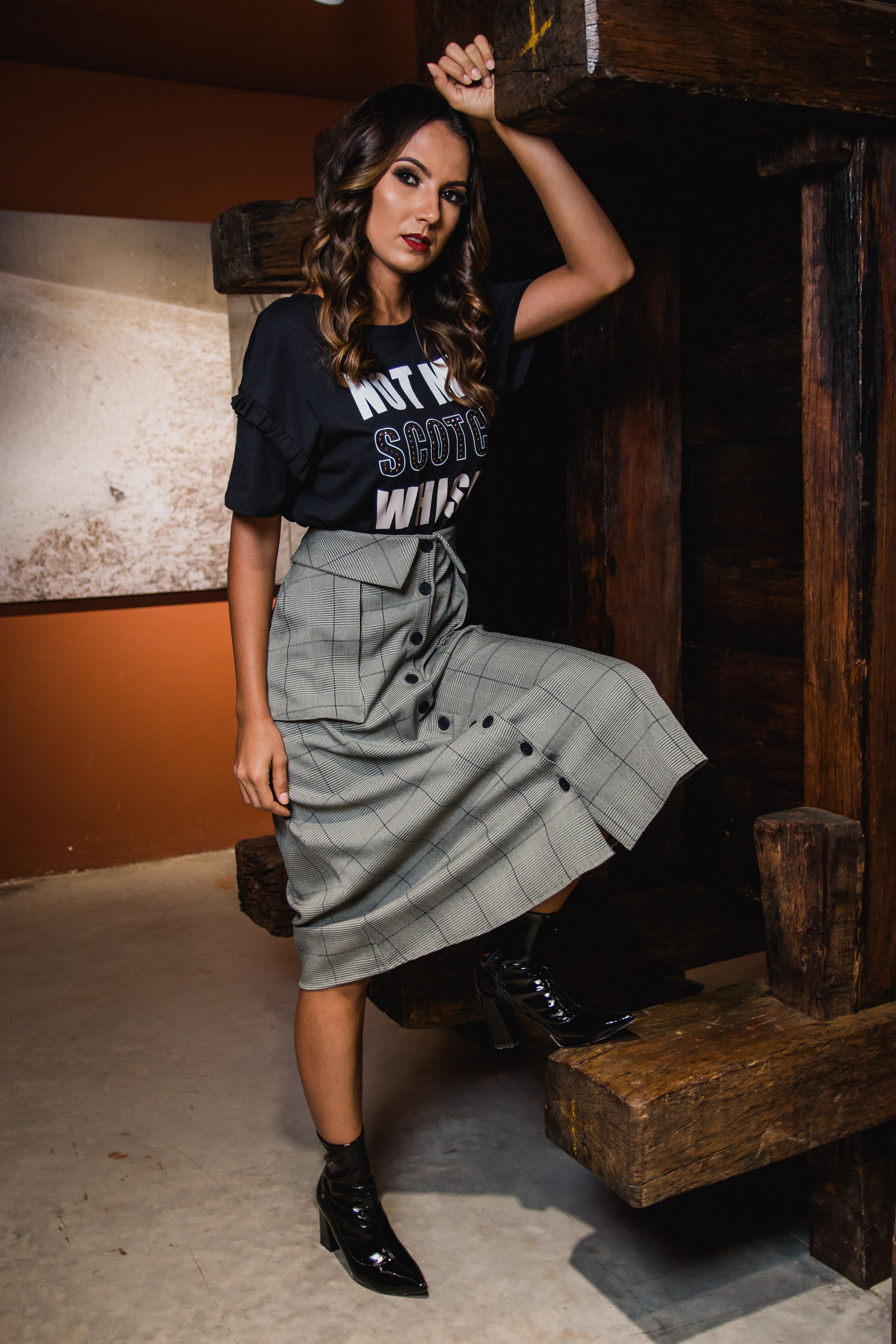
A skirt looks like the easy garment in the range. One tube, one waist, one hem. Then the first sample lands, and the waistband gapes, the pleats fall soft where you wanted them pressed, and the sweep hangs an inch off. A skirt has fewer parts than a jacket, but almost all the risk sits in two places: the waist treatment and the silhouette. Get those wrong and the pattern doesn't matter. Guru estimates a full spec runs $500-$2,000 per style and takes 5 to 20 hours to build (Guru, 2022). This guide walks every section a skirt tech pack needs, and the exact places skirts fail once they reach the line.
Key Takeaways - A skirt tech pack is a factory-facing spec: flats, points of measure, BOM, construction, and grading across 8 standard sections. - The waistband and the silhouette carry most of the risk. Fitted or elastic, contour or straight, A-line or pencil: each changes the pattern and the grade. - Pleats need type, depth, direction, count, and pressed-or-soft, or the factory guesses. - A full spec runs $500-$2,000 outsourced, or your own time with a free template.
New to the format? Start with our guide on what a tech pack is and the wider tech pack pillar before you spec your first style.
What Is a Skirt Tech Pack?
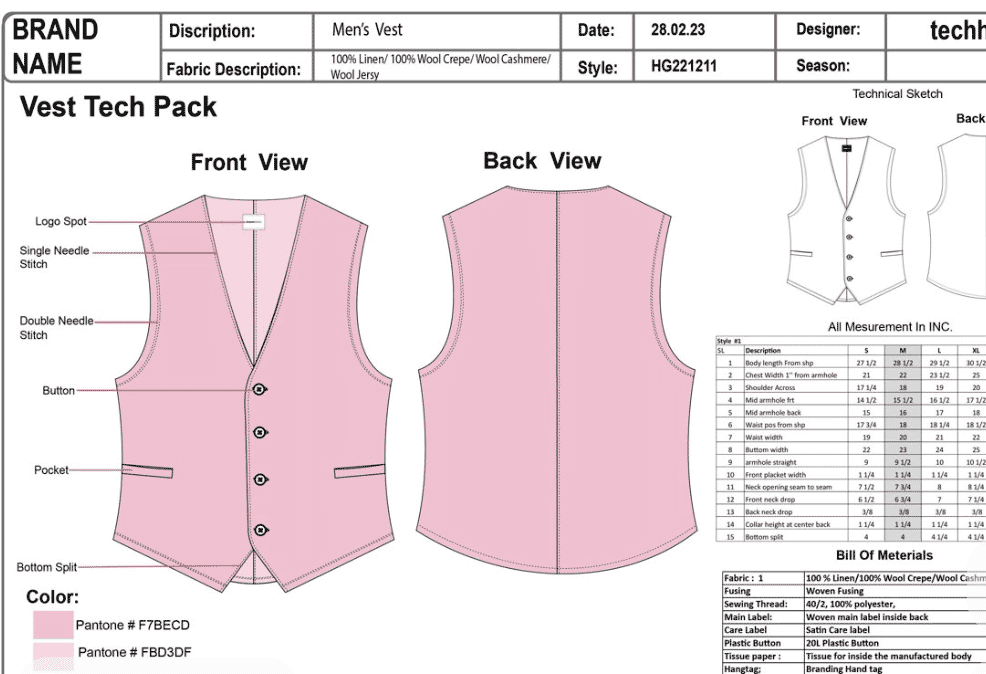
A skirt tech pack is the technical document that tells a factory how to cut, sew, and finish a skirt. It bundles technical flats, a graded measurement chart, a bill of materials, construction notes, closure and waistband callouts, and lining detail into one file. Techpacker calls the tech pack the blueprint every manufacturer needs to build a garment correctly (Techpacker). Without it, the factory fills the gaps with its own habits, and a skirt has a lot of gaps.
The reason a simple-looking skirt needs a full spec comes down to structure. A skirt has no sleeves and no collar, so every design decision loads onto the waist and the hang. How the waistband sits, how the fabric sweeps from hip to hem, whether pleats hold a crease: those choices define the whole garment. Miss one and the skirt reads cheap.
A skirt tech pack translates a skirt design into buildable instructions: flats, points of measure, a bill of materials, waistband and closure callouts, and grading. The tech pack is the blueprint a factory needs to produce a garment accurately, and a skirt loads nearly all of that detail onto the waist and the silhouette.
Across the factories I work with, the skirts that come back wrong rarely fail on the body panel. They fail at the waist. The band is drafted straight when the design called for a contour, so it stands away from the body and gapes at the back. Or the pleats were named "pleated" and nothing else, so the sewing room pressed knife pleats where the sketch wanted soft box pleats. The panels were fine. The spec stopped short.
What Must a Skirt Tech Pack Include?
A complete skirt tech pack covers eight standard sections. Techpacker lists them as flat sketches, a bill of materials, measurement specs, a cost sheet, size gradings, colorways, construction notes, and revision history (Techpacker). Sewport adds that the bill of materials must account for every component, from the shell fabric down to the zip, hook, button, lining, and labels (Sewport). On a skirt, the closure and the waistband detail carry weight far beyond their part count.
For skirts, three sections do the heavy lifting: the waistband and closure callouts, the pleat or silhouette detail on the flat, and the sweep grading. Your flat needs front and back with every dart, seam, pleat, and the closure drawn. Your BOM needs the shell, the lining, the interfacing for the band, and the zip by brand. Your grading needs to state how the sweep grows across sizes, not just the waist.
Our free tech pack template already lays out these eight sections, so you're filling in blanks rather than building the structure yourself.
Why Does the Waistband Carry the Most Risk?
The waistband carries the most risk because it's the one part that has to fit the body exactly, and there are four ways to build it. Fitted or elastic, straight or contour, faced or a separate band: each is a different draft with a different result. Techpacker's construction section exists to remove exactly this ambiguity (Techpacker). Name the band type, or the factory picks the one it sews fastest.
Start with the fit method. A fitted waistband sits at a fixed measurement and needs a closure to get on and off. An elastic waist stretches over the hip, so it forgoes a closure but changes the whole waist spec. You state the relaxed and stretched measurement for elastic, and the exact finished measurement for fitted. These are not interchangeable, and a sample sewn the wrong way fits nobody.
Then the band shape. A straight waistband is cut on a straight grain and suits a waist that sits low, near the hip, where the body is closer to a cylinder. A contour band is cut curved to follow the body as it narrows toward the natural waist, so it hugs instead of gaping. Get this backward and a high skirt stands away from the back at the waist every time.
A skirt waistband can be fitted or elastic, straight or contour, faced or a separate band, and each is a distinct draft. The construction section of a tech pack exists to specify build detail like this precisely. A contour band follows the body's curve; a straight band cut for a high waist gapes at the back.
The closure lives with the waistband. Most fitted skirts use an invisible zip, set either centre back or left side seam, finished with a hook-and-bar or a button at the top. Name the placement, the zip brand and length, and whether it's invisible or exposed. A centre-back zip and a side zip are different patterns, so this isn't a detail you leave to the floor.
Where does the waist actually sit?
Rise decides everything above the hip. A skirt's rise is the vertical distance from the waist seam to where the skirt sits on the body, and it changes which band shape works. A low rise near the hip reads as a near-cylinder, so a straight band behaves. A high rise climbs toward the natural waist, where the body curves in, so it needs a contour band and a shorter, tighter grade. State the rise in centimetres from the waist seam, and note whether the skirt sits on, above, or below the natural waist. That one line tells the factory which draft to pull.
Here's a call most spec sheets fumble. Rise and band shape aren't two separate decisions, they're one. The moment you push the rise above the hip, a straight band stops working, no matter how carefully it's sewn, because the body is narrowing under it. I've watched factories build a beautiful straight band to spec, and it still gaped, because the spec asked for a high rise and a straight band in the same breath. Pick the rise first. The band shape follows from it.
Faced band or separate band?
A separate waistband is a distinct piece of fabric seamed to the skirt body, folded and topstitched, usually interfaced to hold its shape. A faced waistband has no visible band at all: the waist edge is finished with an inner facing that turns to the inside, so the skirt reads clean at the top. The two are different patterns and different BOM lines. A faced waist needs a facing piece and its own interfacing; a separate band needs the band piece dimensioned for height and length. Name which one, and give the band height if it's separate, because a 3 cm band and a 5 cm band sit and grade differently.
Full elastic or back-only?
Elastic changes the waist spec entirely. A full elastic waist runs the elastic all the way around inside a casing or a turned band, so the skirt pulls on and skips the closure. A back-only elastic keeps a flat, fitted front for a clean look and gathers only the back onto elastic, which fits a wider size range off one pattern. For either, spec the elastic by width and type, the relaxed length cut, and the stretched measurement. A 2.5 cm knitted elastic and a 4 cm woven elastic behave nothing alike, so the width and type belong in the BOM, not just the word "elastic".
The curtain and the interlining
The curtain and interlining are the hidden layers that keep a waistband from rolling. Interlining, a fusible or sew-in interfacing, stiffens the band so it stands instead of collapsing over on itself. A waistband curtain is a finishing strip stitched inside the top edge of tailored skirts, gripping a blouse and hiding the raw seam. Neither shows on the outside, so both get skipped in a rushed spec, and the sample comes back with a band that folds over. Name the interfacing by weight and type, and call the curtain if the skirt is tailored.
How Do You Spec Pleats in a Skirt Tech Pack?
You spec pleats by naming five things: type, depth, direction, count, and whether they're pressed or soft. A pleat labelled only "pleated" tells the factory almost nothing, and a pleated skirt tech pack fails more often on this than on any panel. Sewport stresses that construction detail must be defined precisely so the factory builds to intent, not to guess (Sewport). Pleats are pure construction, so they need every one of those five specs.
Type comes first. Knife pleats all fold the same direction and give a crisp, uniform look. Box pleats fold away from each other and sit flat and structured. Inverted pleats fold toward each other, hiding the fold underneath. These read completely differently on the body, so a flat that shows the fold direction beats any single word.
Then the numbers. Depth is how much fabric each pleat takes up, and it drives your fabric consumption and your finished sweep. Direction is which way each pleat faces, drawn on the flat. Count is how many pleats go around, which sets the waist-to-hip ratio. Pressed pleats are heat-set to hold a sharp crease; soft pleats fall as gathers with no crease. That last call changes the fabric choice and the finishing, so state it plainly.
Pleats need five specs: type (knife, box, or inverted), depth, direction, count, and pressed or soft. Sewport states construction detail must be defined precisely for the factory to build to intent (Sewport). "Pleated" with no further detail is why a box-pleat design comes back as knife pleats, or soft where you wanted pressed.
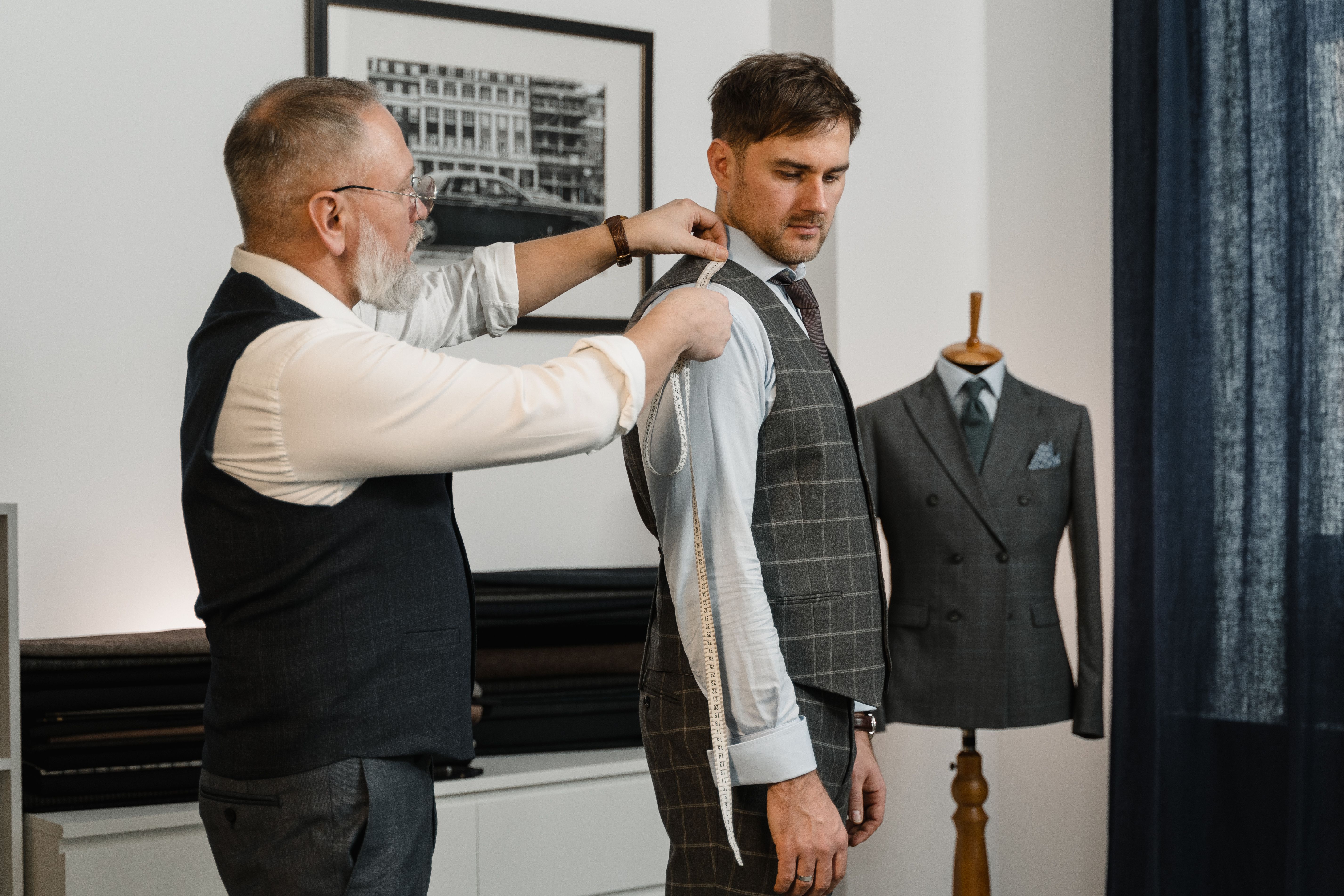
Here's what most spec guides skip about pleats. The pleat depth isn't just a look, it's a measurement input. Every pleat folds away a fixed amount of fabric, so your pleat count times your pleat depth decides how much bigger your cut waist is than your finished waist. If your pleat spec and your points of measure don't agree on that math, the factory can hit the finished waist or the pleat count, not both. One of them gives, and it's usually the one you cared about.
Darts and pleat intake: the shaping math
Darts and pleats both remove fabric to shape the waist-to-hip curve, and both need a stated intake. A dart intake is the width of fabric pinched out at the waist, usually 1 to 2.5 cm per dart on a fitted skirt, and it sets how sharply the waist draws in from the hip. State the dart count, the intake per dart, and the dart length down the body. A pleat's intake is its depth times two, since the fold doubles back on itself. Get the total intake wrong across darts and pleats, and the waist either won't close over the hip or hangs loose.
Topstitched or only pressed?
Whether a pleat is topstitched or only pressed is a construction call with a real look and a real cost. A topstitched pleat is stitched down for several centimetres from the waist, so it holds its fold flat over the hip and releases lower, which controls exactly where the skirt starts to swing. A pressed-only pleat is creased but free from the waist, so it opens sooner and moves more. State the topstitch length down from the waist, or the pleat swings from the wrong point. This is the kind of detail an inspector measures on the finished garment, so leave it out and there's nothing firm to check.
How Does Silhouette Set the Sweep and the Grade?
The silhouette is the single decision that reshapes the whole pattern, because it sets the sweep and how the sweep grades across sizes. A-line, pencil, pleated, and circle skirts share a waist and diverge everywhere below it. Techpacker's grading section exists so those size-to-size changes are defined, not improvised (Techpacker). Name the silhouette, then grade the sweep to match it, or the size run drifts.
Each silhouette moves fabric differently. A pencil skirt is straight or tapered, so the hem sweep sits close to the hip measurement and grades in small, even steps. An A-line flares gently from the hip, so the sweep grows faster than the waist. A full circle skirt draws its hem from a radius, so the sweep is huge and grading it is a geometry problem, not a fixed add-per-size. A pleated skirt hides its sweep inside the pleats, so the grade lives in the pleat depth and count.
Skirt silhouette sets the hem sweep and how it grades: pencil grades in small steps, A-line flares faster than the waist, and a circle skirt's sweep is a radius calculation. The grading section of a tech pack exists to define these size-to-size changes, so the sweep can't just inherit the waist's grade rule.
Woven or knit changes all of it. A woven skirt holds its shape and relies on darts, a yoke, or seams to shape the waist-to-hip curve, so those need placement on the flat. A knit skirt stretches, often ditching the closure for a pull-on elastic or self waist, and grades on stretch rather than fixed measurement. State the fabric type up front, because it decides whether darts, a zip, and a contour band even belong in the spec. For a garment that shares this waist-and-hang logic, our dress tech pack guide covers the same silhouette calls one seam further up.
The pencil and straight blocks
A pencil skirt runs straight from hip to hem or tapers slightly inward, so its sweep sits at or just under the hip. It needs a walking vent or slit, because a hem that narrow gives no stride room on its own. Spec the vent length and the taper, stated as the difference between hip and sweep. A straight skirt is the same block without the taper: sweep equals hip, it hangs like a tube, and it grades in even steps. Both lean on darts or a shaped yoke to draw the waist in, so those belong on the flat.
The A-line and flared blocks
An A-line flares gently and evenly from the hip to a wider hem, so the sweep grows faster than the waist across the size run. It usually clears the legs without a vent. Spec the flare as the hem sweep against the hip, and grade the sweep on its own rule, not the waist's. A more extreme flared or trumpet block adds volume low, sometimes with a seamed flounce, which needs the flare start height marked on the flat so the swing begins where you want it.
Pleated blocks: knife, box, and accordion
Pleated blocks hide their sweep inside the folds, so the grade lives in pleat depth and count rather than a plain hem number. Knife pleats all face one way for a uniform swing. Box pleats alternate outward folds for structured volume. Accordion pleats are narrow, heat-set zigzags running the full length, which need a permanent-press finish and a fabric that holds it. Each reads differently and eats fabric differently, so name the pleat family and set the depth, count, and press before you cost the style.
Circle, wrap, and tiered blocks
A circle skirt cuts its hem from a radius, so the sweep is enormous and grading it is geometry, not a fixed add per size. A wrap skirt overlaps two front panels that tie or button, so it needs the overlap width, the tie or closure placement, and a clean finish on the wrap edge. A tiered skirt stacks gathered panels, each tier wider than the one above, so every tier needs its own cut-to-finish gather ratio. These three carry the most fabric and the most finishing, which is why they cost toward the top of the range.
What Measurements Does a Skirt Tech Pack Need?
A skirt tech pack needs a compact but specific set of points of measure, each with a target and a tolerance. Waist, hip, hip drop, length, sweep, and pleat depth cover most styles, and each grades on its own logic. ASTM maintains dimensional and grading standards so those numbers carry defined tolerances instead of eyeballing (ASTM D5585-21). A skirt has fewer points than a jean, but the sweep and pleat depth are ones a trouser never needs.
Measure at the right spots and say where. Waist is taken relaxed and flat, times two. Hip is measured at the fullest point with the hip drop telling the factory how far below the waist that sits. Length runs centre back from waist seam to hem. Sweep is the full hem width flat, and it's the number that proves your silhouette. Below is an illustrative points-of-measure table for a base size medium skirt. Treat the numbers as an example of format, not a house standard.
| Point of Measure | Base Size M | Tolerance |
|---|---|---|
| Waist, relaxed (half, laid flat) | 38 cm | ±0.5 cm |
| Hip, at fullest (half, laid flat) | 51 cm | ±1 cm |
| Hip drop, waist seam to hip line | 20 cm | ±0.5 cm |
| Length, CB waist to hem | 56 cm | ±1 cm |
| Sweep, hem (half, laid flat) | 76 cm | ±1 cm |
| Pleat depth (each) | 2.5 cm | ±0.3 cm |
A skirt tech pack needs waist, hip, hip drop, length, sweep, and pleat depth, each with a target and tolerance. ASTM maintains the dimensional standards behind those tolerances (ASTM D5585-21). Sweep and pleat depth are the two a trouser never carries, and they're where a skirt's silhouette is proven or lost.
The lining and hem deserve a line each. A lined skirt needs the lining drafted a touch shorter than the shell, named in the BOM, and its own hem finish. State the hem allowance and finish too, blind-stitch, machine, or bound, since a heavy hem sweep hangs differently from a light one. For the errors that repeat across every garment type, our guide to common tech pack mistakes is worth a read before you finalise the chart.
How Do You Spec the Lining and Hem?
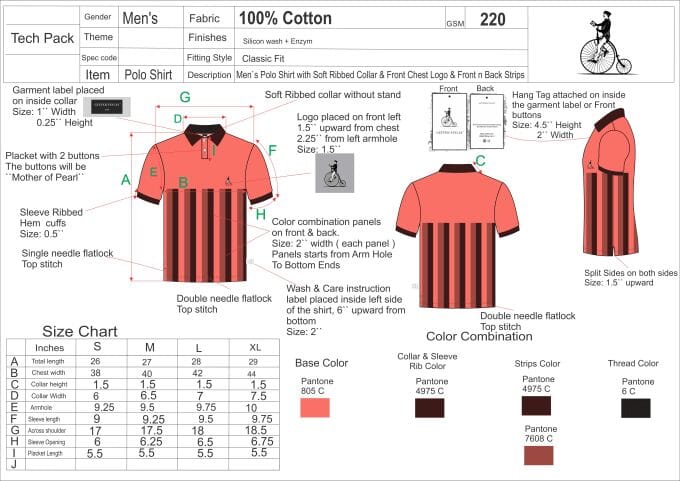
A lined skirt needs the lining named as its own material, drafted shorter than the shell, with its own hem finish, or it peeks below the hem on the first sample. Sewport states the bill of materials must account for every component, from the shell fabric down to the lining and labels (Sewport). A lining is a full second garment inside the skirt, so it earns real detail, not a note in the margin.
Attached, free-hanging, or slip lining?
An attached lining is joined to the shell at the waist and sometimes the hem, so the two move as one and the skirt reads structured. A free-hanging lining connects only at the waist and swings independently, which suits fuller silhouettes that need the shell to move over a still under-layer. A slip lining is a separate under-layer, almost a built-in slip, used where the shell is sheer or clingy. State which construction, because it changes the waist seam, the hem, and how the lining grades.
Why a lined skirt needs its own lining POM
A lined skirt needs its own lining points of measure because the lining is drafted to different numbers than the shell. The lining hem sits 1 to 2 cm above the shell hem so it never shows, and its sweep is often cut slightly narrower or with its own pleat to allow walking room. If the tech pack only measures the shell, the factory guesses the lining, and it either drags below the hem or pulls the shell tight from inside. Give the lining a waist, a hip, a length, and a sweep of its own.
The lining is the single detail I see skipped most on skirt specs that otherwise look finished. The shell is measured to the millimetre, the pleats are drawn, the BOM is clean, and then the lining is one line that says "self-coloured lining". The sample comes back with the lining hanging a centimetre below the hem, or so tight it drags the shell in at the walk. A lining you don't measure is a lining the factory drafts by eye, and eyes disagree.
Hem finish and hem grading
The hem finish decides how the skirt hangs at the edge, and it grades with the sweep. A blind hem hides the stitch for a clean drape on fitted and tailored skirts. A topstitched hem shows one or two rows of stitching, casual and durable. A horsehair braid sewn into the hem stiffens a full sweep so it holds a bell shape instead of collapsing, standard on circle and formal skirts. State the hem allowance, usually 2 to 4 cm, and remember the hem circumference grows every size, so the hem finish has to grade with the sweep, not sit at a fixed length.
A lined skirt needs the lining as its own material with its own points of measure, drafted shorter than the shell so it never shows below the hem. ASTM maintains the dimensional standards those measurements grade against (ASTM D5585-21). Attached, free-hanging, and slip linings each change the waist seam and the hem.
How Do Vents and Slits Give a Skirt Walking Ease?
A narrow skirt needs a vent, slit, or kick pleat because a hem cut close to the hip leaves no room to stride, and the seam splits if you force it. Walking ease is the extra hem room a body needs to move, and ASTM's body-measurement standards define the dimensions garments grade against (ASTM D6960). On a pencil skirt the vent isn't decoration. It's what lets the wearer climb a stair.
Vent, slit, or kick pleat?
A vent is an overlapped opening, one edge lapping the other, so the skirt stays closed when still and opens to walk. A slit is a plain open split with both edges finished separately, so it shows more leg and gives the same ease with a sharper look. A kick pleat is a hidden inverted pleat at the hem, usually centre back, that releases fold for walking room without an open gap. Name which one, its placement, and its length up from the hem, because a 15 cm vent and a 25 cm slit walk and read completely differently.
How much ease does the sweep need?
How much walking ease a skirt needs comes down to its sweep against the stride. As a working rule, a straight skirt's hem wants a vent or slit once the sweep drops within a few centimetres of the hip, since the hem can't stretch to a step. Fuller silhouettes build ease into the flare and skip the vent. State the ease decision on the flat, because a factory won't add a vent you didn't draw, and a pencil skirt without one tears at the back seam on the first proper stride.
A narrow skirt needs a vent, slit, or kick pleat for walking ease, since a hem cut near the hip gives no room to stride. ASTM's body-measurement standards define the dimensions garments grade against (ASTM D6960). A vent overlaps and stays closed; a slit is an open split; a kick pleat hides an inverted fold.
Inspection and AQL: how does a skirt pass or fail?
Inspection judges a skirt numerically, so every measurement needs a stated tolerance. Factories inspect finished goods by AQL sampling under ISO 2859-1, also published as ANSI/ASQ Z1.4, pulling a sample and counting defects against a defined limit. QIMA reports AQL 2.5 as the most common commercial limit, AQL 1.0 for higher-risk goods, AQL 4.0 for minor cosmetic defects, and a zero limit for critical defects (QIMA). A skirt with a gaping waist fails the same way a broken zip does.
This is why the waistband spec and the measurement chart can't disagree. Inspection measures the finished garment against your tolerances. If your pleat count and finished waist imply different fabric math, or the sweep isn't stated, the inspector has nothing firm to measure, and a whole run can pass or fail on a judgment call you left open. State every tolerance, list defects that count as critical, major, or minor, and the inspection has a rulebook.
A skirt passes or fails inspection by numbers, not opinion. AQL sampling under ISO 2859-1 checks a run against defined limits, and QIMA reports AQL 2.5 as the most common commercial standard (QIMA). A skirt whose finished waist sits outside tolerance fails the same inspection as one with a faulty zip.
How Much Does a Skirt Tech Pack Cost?
A skirt tech pack costs $500-$2,000 per style if you outsource it, or your own time if you build it. Guru estimates that range and puts the work at 5 to 20 hours per style (Guru, 2022). A plain pencil skirt sits toward the lower end. A pleated or circle skirt with a lining and a contour band climbs, because the pleat spec, the sweep grading, and the waistband detail all add real work.
You can still build one yourself for the cost of your time. A structured template gets you most of the way, since the eight sections are the same across garments and only the content changes. Fill in the sections, add graded POMs with tolerances, and pin down the waistband type, the closure, the pleats, and the sweep. That's a working spec a factory can quote against.
Building a skirt spec yourself costs only your time, since the eight standard sections are the same across garments. Those sections are the fixed blueprint a factory needs, so a template lets you fill in waistband, pleats, and sweep grading rather than build the structure from scratch.
Need this done properly without building it yourself? Our tech pack service delivers a factory-ready skirt spec from $299, with graded measurements, a full BOM, and waistband, pleat, and sweep callouts checked against real production requirements. Grab our tech pack template if you'd rather start free. If you want a manufacturer's view on how these specs get read on the floor, Portugal Clothing Factory publishes on the production side.
What Do You Hand the Factory?
You hand the factory one file that leaves nothing to guess: flats, a graded POM chart, a full BOM, waistband and closure callouts, pleat or silhouette detail, lining spec, and inspection tolerances. Guru puts building that spec at 5 to 20 hours per style (Guru, 2022), and the hours pay off in samples that come back right. A complete file is what a factory quotes and cuts against, and a thin one is what gets you a floor guess.
The checklist below is the minimum a skirt hand-off carries. Each row is a thing the factory can't invent for you without risking the fit or the look. Miss one, and it comes back as a question, a delay, or a wrong sample.
| Hand-off item | Why the factory needs it |
|---|---|
| Front and back technical flats | Show every seam, dart, pleat, and the closure to scale, so the pattern room cuts to intent, not habit. |
| Graded POM chart with tolerances | Give a target and a pass band for every size, so inspection has firm numbers to measure against. |
| Full BOM with trims by brand | Name shell, lining, interfacing, thread, zip, hook, and button, so nothing gets substituted on the floor. |
| Waistband and closure callout | State fitted or elastic, straight or contour, and the zip type and placement, so the band is drafted right the first time. |
| Pleat or silhouette detail | Fix pleat type, depth, direction, and count, or the block itself, so the sweep matches the design. |
| Lining spec and lining POM | Name the lining construction and give it its own measurements, so it never drags below the hem. |
| Hem and vent detail | Set the hem finish, allowance, and any vent length, so the skirt hangs and walks as drawn. |
| Inspection tolerances and defect classes | Define what passes, so AQL sampling accepts or rejects the run on rules, not opinion. |
A skirt hand-off is one file: flats, graded POMs, a full BOM, waistband and closure callouts, pleat or silhouette detail, lining spec, and inspection tolerances. Guru puts the build at 5 to 20 hours per style (Guru, 2022). A complete file is what a factory quotes and cuts against.
Frequently Asked Questions
What should a skirt tech pack include?
A skirt tech pack covers eight standard sections: technical flats, a bill of materials, graded measurements, a cost sheet, size grading, colorways, construction notes, and revision history. For skirts, weight the waistband and closure callouts, the pleat or silhouette detail, and the sweep grading, since those carry the risk.
How do you spec a pleated skirt tech pack?
Name five things per pleat: type (knife, box, or inverted), depth, direction, count, and pressed or soft. Draw the fold direction on the flat, not in words. Pleat depth times count decides how much wider your cut waist is than your finished waist, so it has to agree with your points of measure.
What is the difference between a straight and a contour waistband?
A straight waistband is cut on straight grain for a waist that sits low near the hip, where the body is closer to a cylinder. A contour band is cut curved to follow the body as it narrows toward the natural waist. Use a straight band high on the waist and it gapes at the back.
How many measurements does a skirt tech pack need?
Most skirts need six to eight points of measure: waist, hip, hip drop, length, sweep, and pleat depth where relevant, each with a target and tolerance. ASTM's dimensional standards exist so those tolerances grade consistently across sizes (ASTM D5585-21). Sweep and pleat depth are the skirt-specific ones.
Does an A-line skirt tech pack grade differently from a pencil skirt?
Yes. A pencil skirt's hem sweep sits close to the hip and grades in small, even steps. An A-line flares from the hip, so the sweep grows faster than the waist and needs its own grade rule. A circle skirt's sweep is a radius calculation, not a fixed add per size.
Does a lined skirt need its own measurements?
Yes. A lining is a full second garment inside the skirt, drafted to its own numbers. Give it a waist, hip, length, and sweep. The lining hem sits 1 to 2 cm above the shell hem so it never shows, and its sweep allows walking room. Measure only the shell and the factory guesses the rest.
What is the difference between a vent, a slit, and a kick pleat?
A vent is an overlapped opening that stays closed when still. A slit is a plain open split that shows more leg. A kick pleat is a hidden inverted pleat at the hem that releases room without a gap. Name which one, its placement, and its length up from the hem, because each walks and reads differently.
How do you spec an elastic waistband?
Spec the elastic by width and type, the relaxed length cut, and the stretched measurement. A full elastic waist runs all the way around and pulls on. A back-only elastic keeps a flat, fitted front and gathers only the back. A 2.5 cm knit and a 4 cm woven elastic behave nothing alike, so state both.
Peter Midea runs a network of 80 clothing factories in Portugal and has watched more garments get rejected on a production line than he'd like to admit.
We build the factory-ready spec a manufacturer can quote from without a single question: technical flats, bill of materials, graded points of measure with tolerances, colorways and construction notes. $299 per style, 3 to 5 working days, 2 to 3 revision rounds.
Get your tech pack — $299Start with the free templateWe don't take your production. The spec is yours to send to any factory, anywhere. Talk to us first if you're not sure what you need.
Sources
Every statistic and definition in this article traces to one of the following. Each is listed once here, and cited inline where it is used.
- Guru
- Techpacker
- Sewport
- images.pexels.com
- ASTM International
- otextilpt.sirv.com
- ASTM International
- QIMA
- Portugal Clothing Factory
Related guides
- Tech packs: the complete guide
- Dress tech pack
- Free tech pack template