Contents
- What is a tech pack, and what does it actual…
- What goes inside a garment tech pack, sectio…
- How does a thin tech pack become a rejected…
- What does a tech pack cost?
- What tech pack format do factories actually…
- How do you build a clothing tech pack, step…
- How does a tech pack change across the sampl…
- What do good tech pack samples look like?
- Should you write your own tech pack or hire…
- Tech packs and 3D sampling: where this is he…
- Frequently asked questions
- What to do next
A factory does not read your mind. It reads your document. When a pattern cutter opens your file at seven in the morning and the chest measurement is missing, he does not call you. He picks a number that looks right, cuts fifty units, and moves on. That is how a good design quietly becomes a bad garment. For the measuring itself, see our guide on how to measure garments.
The document that prevents this is the tech pack. Professional fashion designers charge between $500 and $2,000 to prepare a standard one (Guru, 2022), which tells you something about how much real work sits inside it. This guide covers what a tech pack is, every section it needs, the format that survives contact with a production floor, what it costs, and how the document changes as your sample rounds progress.
Key Takeaways
- A tech pack is the technical specification a factory manufactures from: sketches, materials, measurements, construction.
- Missing points of measure do not stall production. They get guessed, and the guess ships.
- Designers charge $500 to $2,000 per standard tech pack.
- Your garment is accepted or rejected against a sampling standard, not against your taste.
If you want to work along with a real document while you read, our free factory-tested tech pack template already has every section in this guide laid out, including the tolerance column most brands forget. Drawing your flats in Illustrator? Start from the Illustrator tech pack template instead.
What is a tech pack, and what does it actually do?
A tech pack is a document containing all the technical information about your product (Sewport). Put more precisely, a technical pack sets out every design and technical specification of a garment. It is not a mood board. It is not a lookbook. It is a manufacturing instruction set. Our guide to the manufacturing specification covers what each section has to contain and how to write it.
Think of the difference between describing a house and handing over blueprints. A designer can describe an oversized hoodie for ten minutes and two factories will build two different garments. Give both factories a tech pack with a 62cm chest half-measurement, a 320gsm loopback fleece, and a twin-needle coverstitch on the hem, and they build the same hoodie. That is the whole trick.
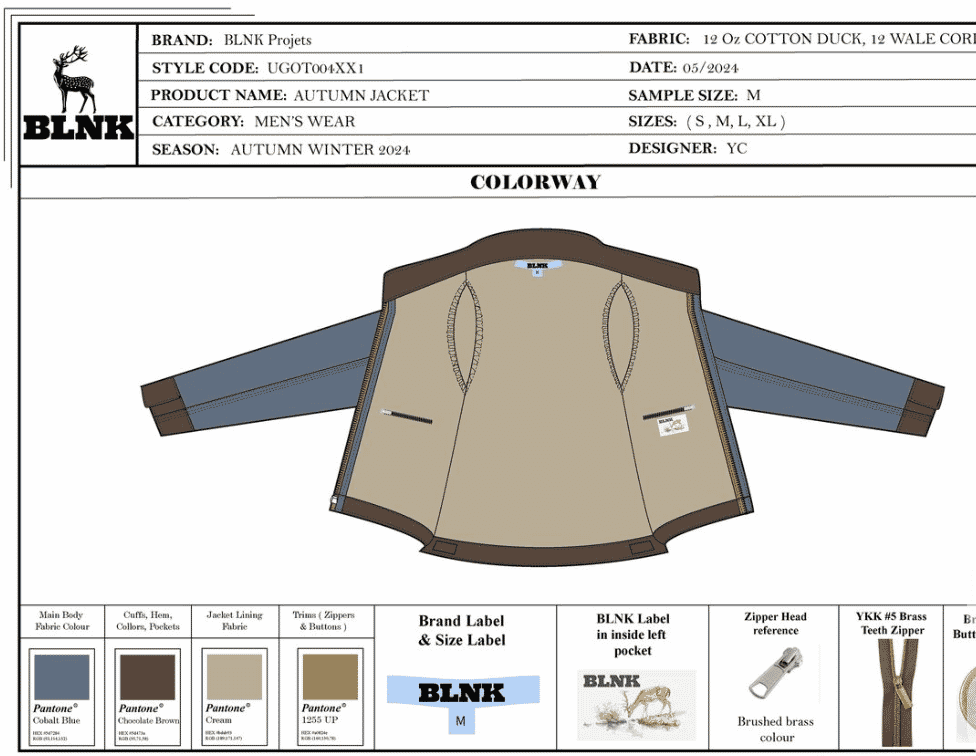
A tech pack is the technical specification sheet a clothing brand sends to a factory. It sets out every design and technical specification of a garment, typically covering flat sketches, a Bill of Materials, graded measurement specs, colorways, construction notes, and revision history. Factories cut, sew, cost, and inspect against it.
The document does three jobs at once, and brands usually think about only the first. It tells the factory what to build. It gives the factory something to quote against, because a costing team cannot price a feeling. And it defines what counts as a defect later, when finished units come off the line and get inspected. That third job is the one that decides whether you get your money back.
The search terms shift around, the object does not. Tech pack, technical pack, spec sheet, tech sheet. I have heard sample rooms call it simply "the file." Whatever it gets called, it is the one thing both sides point at when a garment turns out wrong, which is precisely what makes it worth building properly.
In practice, the tech pack is the first thing a factory asks for and the fastest way it decides whether to quote you seriously. A brand that sends three JPEGs and a Pinterest link gets a slow, padded, defensive price, because the factory is pricing its own uncertainty. A brand that sends a clean spec gets a real number. Nobody says this out loud. It happens anyway.
For the short version of this answer, we keep a standalone piece on what a tech pack is, with an annotated example you can scroll through in two minutes.
Tech pack, spec sheet, or line sheet: what's the difference?
These three get used as if they were interchangeable, and they are not. A clothing tech pack is the full build document: measurements, Bill of Materials, construction notes, tolerances, the file a factory actually cuts from. A spec sheet is narrower, usually just the measurement page of that document, the table of points of measure and tolerances handed over on its own. A line sheet is a different object entirely, a sales document that lists styles, colourways, wholesale prices, and order minimums for buyers, carrying no construction data at all.
So a tech pack for clothing production and a line sheet point in opposite directions. The apparel tech pack faces inward, at the factory that has to build the garment. The line sheet faces outward, at the wholesale buyer deciding whether to stock it. A tech pack for clothing lives on the cutting table; a line sheet lives in the showroom. Confusing them is expensive: send a factory a line sheet and it cannot quote, because there is nothing to cost against, and send a buyer a full fashion tech pack and you have handed a wholesale account your grade rules and supplier references for nothing.
When someone says "send me the spec," ask which they mean. A clothing tech pack, a one page spec sheet, and a line sheet are three different promises, and only one of them gets your garment made.
What goes inside a garment tech pack, section by section?
The standard sections of a technical pack are flat sketches, Bill of Materials, garment measurement specs, cost sheet, size gradings, colorways, construction notes, and revision history. Every one of those exists because a factory once got something wrong without it. Skip a section and you are re-running that experiment with your own money.
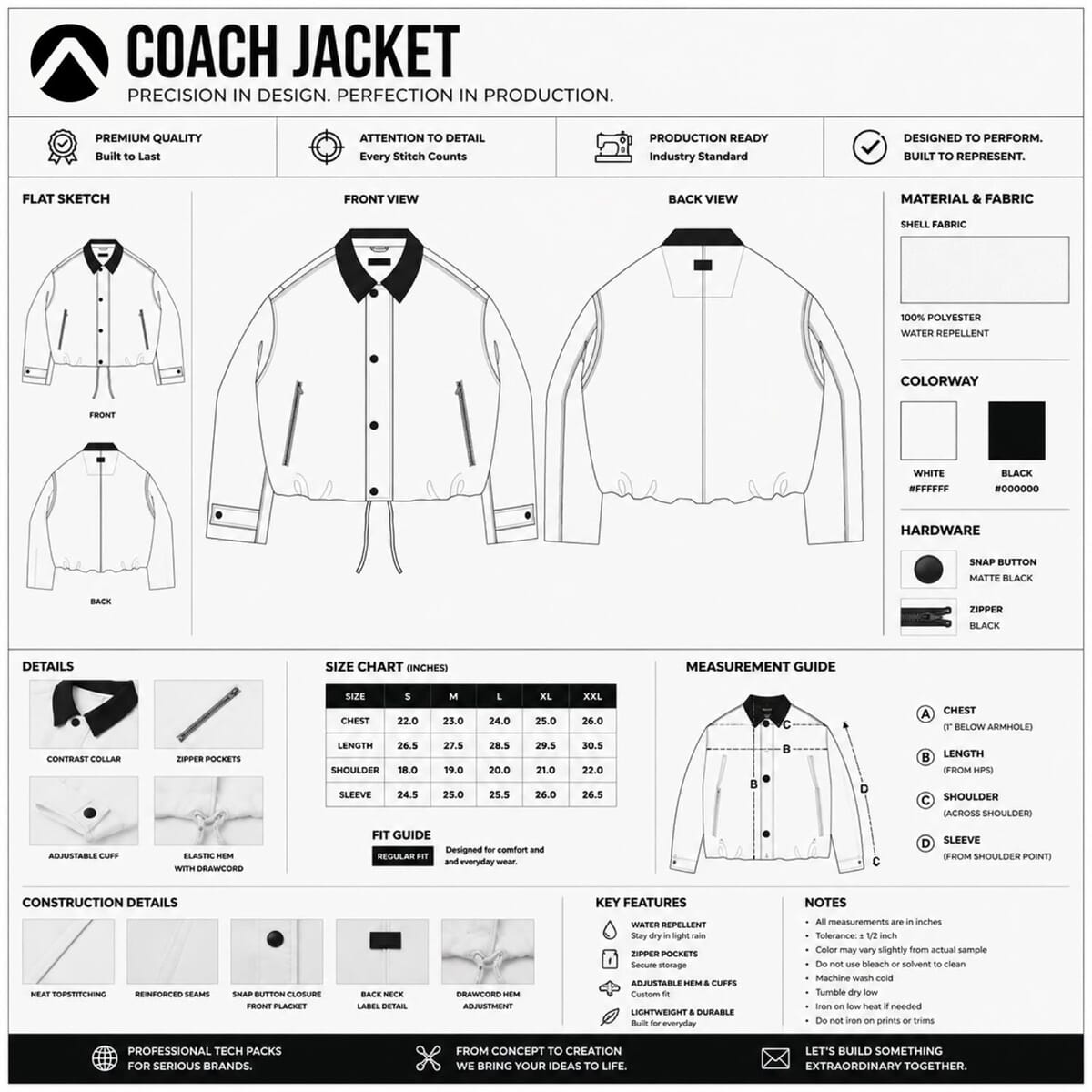
A complete apparel tech pack contains eight core sections: flat sketches, Bill of Materials, garment measurement specs, size gradings, colorways, construction notes, cost sheet, and revision history. Each section maps to a decision a factory would otherwise make on your behalf, without asking, on the production floor.
Here is what each section holds, what a factory actually needs from it, and where founders go wrong.
Cover page and style overview
The cover page carries the style name, the style number, the season, the brand, the date, and the revision number. It reads like admin. It is the most functional page in the document, because it is how a factory knows which version of your garment it is holding in its hands.
What founders get wrong: no style number, and no revision number. Two files called "hoodie_final" and "hoodie_final2" land in the same inbox a week apart, and the sample room prints whichever one opened first. Give every style a number, and never reuse it on a different garment.
Flat sketches
Front, back, and any detail that is not obvious from those two views. Draw them as technical flats: proportional, no shading, no model, no attitude. A flat sketch is a diagram, not a drawing. It shows seam lines, closures, pockets, topstitching, and every visible construction feature at the correct relative scale.
What founders get wrong: callout lines that point at nothing. Every arrow on a flat should terminate in something you have also specified in words, somewhere else in the file. If an arrow has no matching spec behind it, delete the arrow. All it does is generate questions.
Bill of Materials (BOM)
The BOM lists every physical component of the garment: shell fabric, lining, ribbing, interlining, thread, zips, buttons, drawcords, eyelets, elastic, labels, hangtags, polybags. Each row needs a composition, a weight, a colour reference, a supplier or supplier reference, a placement, and a quantity per garment.
"Cotton jersey" is not a BOM row. "180gsm 100% combed cotton single jersey, Pantone 19-4005 TCX, supplier ref XYZ, shell, 1.4m per garment" is a BOM row. The distance between those two lines accounts for most of the cost variance in a first order.
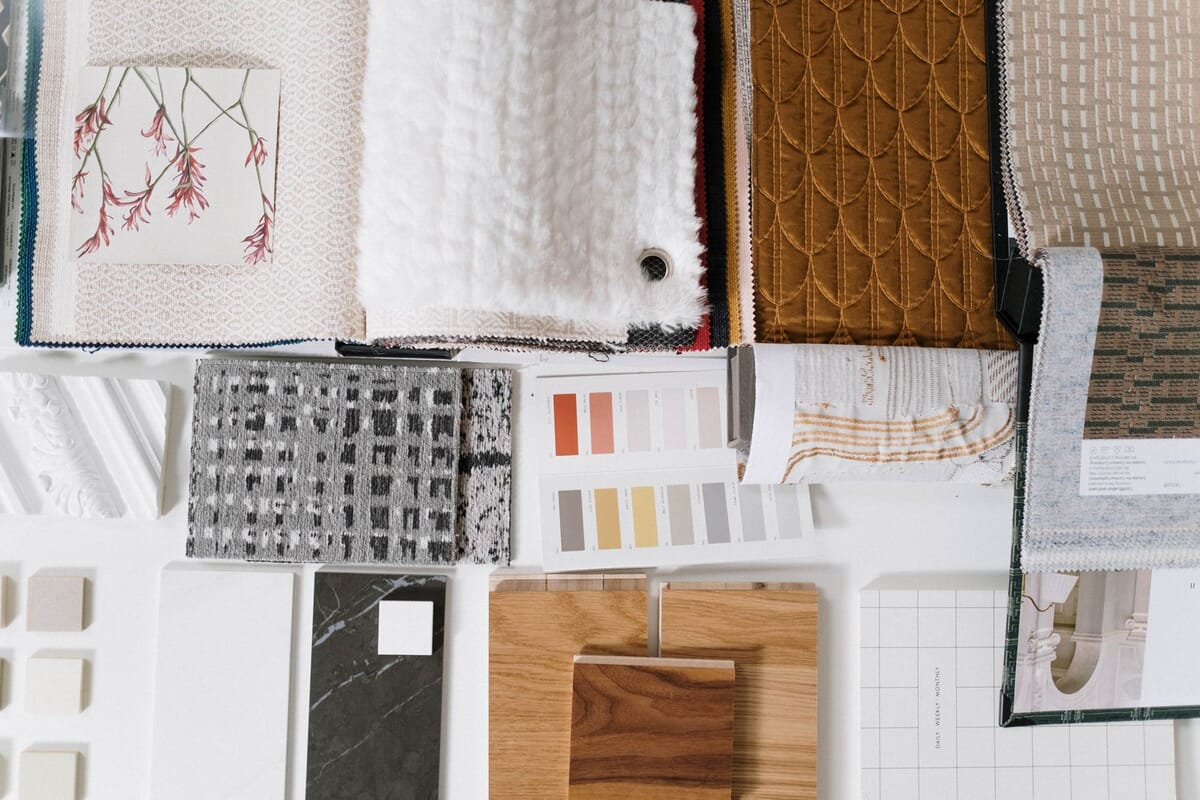
What founders get wrong: they specify the shell fabric and forget the trims. Thread, labels, and interlining are real components with real colours and real costs. A factory that has to choose your thread will choose whatever is already on the machine.
Garment measurement specs (points of measure)
This is the heart of the tech pack, and the section brands rush hardest. A point of measure, or POM, is a named dimension with a value and a tolerance. Chest width, measured 1cm below the armhole, 56cm, tolerance plus or minus 1cm. That is a complete POM. Anything less is a hint.
A basic t-shirt needs somewhere around twelve to fifteen POMs. A hooded sweatshirt with a zip, pockets, and a lined hood needs considerably more, because each of those components carries its own geometry. Simple rule: if a part of the garment can be made the wrong size, it needs a POM.
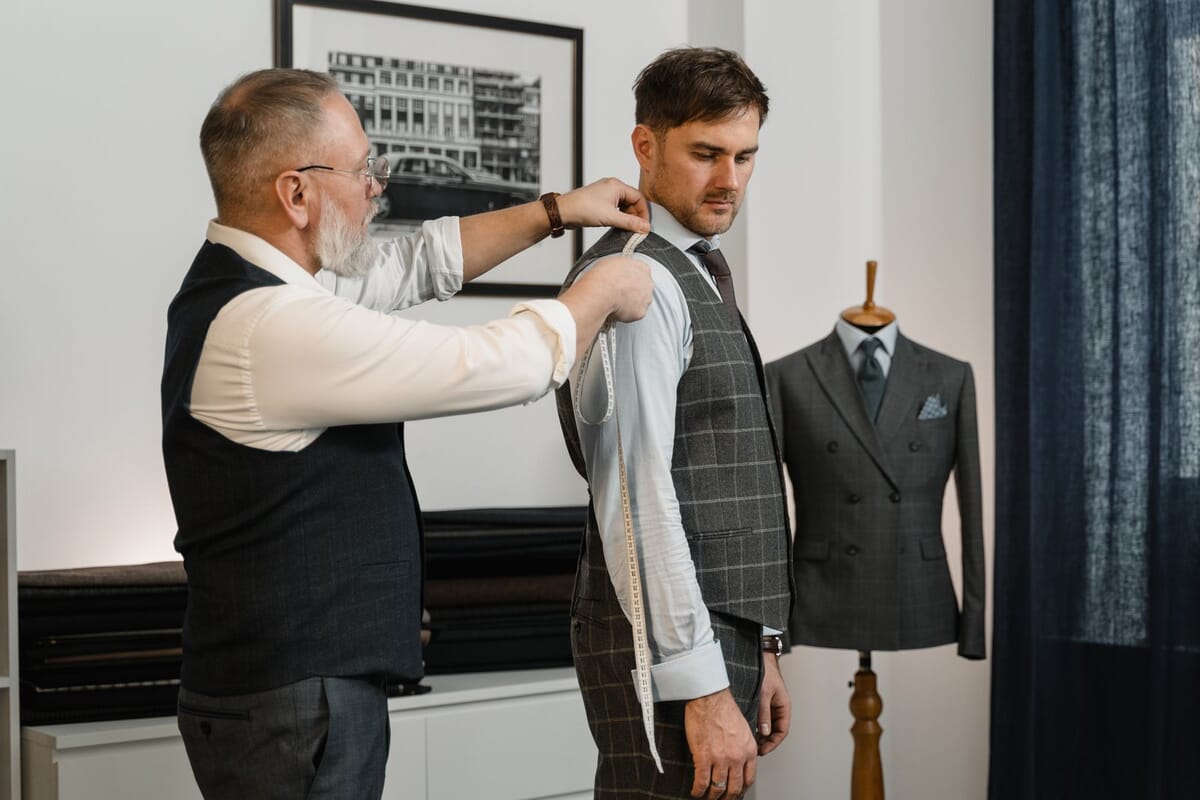
What founders get wrong: measurements without tolerances, and inconsistent names. "Body length" on page four and "CB length" on page seven look like two different dimensions to a stranger reading at speed in a second language. Pick one name per dimension and repeat it everywhere.
Size grading
Grading is how each POM changes between sizes. It is a table, not a rule of thumb. US brands typically grade against ASTM body measurement tables: ASTM D5585-21 covers adult female misses in sizes 00 to 20, and ASTM D6960/D6960M covers plus women's sizes 14W to 40W. Both are maintained by ASTM Subcommittee D13.55, whose entire jurisdiction is body measurement for apparel sizing.
Grading is never uniform. Chest might step 4cm between sizes while the neck opening steps 0.5cm and sleeve length steps 1cm. Apply one flat percentage across every POM and you produce an XL that fits nobody: correct in the chest, absurd at the collar.
What founders get wrong: grading only the sample size and assuming the factory will extrapolate the rest. It will. You will not enjoy the result.
Colorways
Every colour combination you intend to produce, component by component, with Pantone TCX references. Not just the shell. Every visible part of the garment appears in every colourway, and each one needs its own reference.
A black hoodie with a black drawcord, black ribbing, and a black tipped aglet is four separate blacks, arriving from four separate suppliers, and they will not match unless you say so. In grey it gets worse. Grey is where colourways go to die.
What founders get wrong: sending a screenshot of a colour. Screens lie, and so do phone photos. Use Pantone TCX for textiles, and budget for a lab dip round regardless.
Construction notes and callouts
Seam types, stitch types, stitches per inch, topstitch distance from the edge, hem depth, bar tacks, closure type and direction, pocket bag construction, hood lining, label placement. This section separates a twelve euro garment from a forty euro one. It is also the section AI-generated tech packs are worst at, by a wide margin.
Write callouts as instructions, not descriptions. "Coverstitch hem, two needle, 40mm from edge" is buildable. "Clean, modern hem finish" is a feeling. A sewing operator cannot sew a feeling, so she will substitute the finish she uses every day.
Labels, trims, and packaging
Care label content, fibre composition, country of origin, size label, brand label, and where each of them sits, measured from a named seam. Then the packaging: polybag size, hangtag, folding method, carton quantity. This section looks trivial and generates a startling volume of email when it is missing.
What founders get wrong: leaving label placement to the factory. There is no default. A neck label sewn 2cm too low scratches the skin, and the customer returns the garment without ever telling you why.
Cost sheet and revision history
The cost sheet breaks your target price into materials, trims, labour, and margin. It lets you argue with a quote line by line instead of simply accepting or refusing it. The revision history is duller and saves more money: version number, date, what changed, who approved it.
Without a revision history, two versions of the same file circulate and the factory builds the wrong one. That is not a hypothetical failure. It is the most preventable expensive mistake in this entire process, and I see it every season.
How does a thin tech pack become a rejected lot?
Acceptance is statistical, not conversational. Finished garments are inspected against a sampling standard, typically ISO 2859-1 or ANSI/ASQ Z1.4, which sets how many units get pulled from a lot and how many defects are allowed before the lot fails. Your opinion arrives after that decision is already made.
Garment lots are accepted or rejected using statistical sampling under ISO 2859-1 / ANSI-ASQ Z1.4. According to QIMA, AQL 2.5 is the most common standard for general consumer goods, AQL 1.0 applies to higher-risk categories, and AQL 4.0 is used where minor cosmetic defects are acceptable. Critical defects sit at AQL 0.
Here is the mechanism people miss. A tech pack does not only tell a factory what to build. It defines what counts as a defect. A garment can only fail against a specification that exists. If your file says "sleeve length 64cm, tolerance plus or minus 1cm" and a sampled unit measures 66.5cm, that is a measurable defect, it gets counted, and the lot can be rejected. If your file never names sleeve length, then 66.5cm is not a defect. It is just a sleeve.
This is why "the factory ruined my order" is usually the wrong diagnosis. A thin tech pack does not cause chaos on the floor. It causes silence. The pattern cutter fills the gap with a reasonable assumption, the line sews to that assumption, the inspector has nothing to inspect against, and the lot passes cleanly. You discover the problem when the boxes land in your hallway. Nothing failed, because nothing was ever specified.
Tolerance is the other half of this. A tolerance is not a suggestion. It is the width of the acceptable band, and it is a commercial decision you are making whether you write it down or not. Set it too tight on a knit and you will reject garments that are physically fine, because jersey relaxes and rolls. Set it too loose and you have authorised a sloppy fit in writing, with your own approval on it.
Most brands set no tolerance at all. That hands the decision to a stranger who has never met your customer.
| AQL level | Use |
|---|---|
| AQL 0 | Critical defects, zero tolerated |
| AQL 1.0 | Higher-risk categories |
| AQL 2.5 | General consumer goods (most common) |
| AQL 4.0 | Minor cosmetic defects acceptable |
Source: QIMA, based on ISO 2859-1 / ANSI-ASQ Z1.4.
There is a commercial edge to this that has nothing to do with factories. US retail returns reached $890 billion in 2024, and 76% of consumers say free returns influence where they shop (NRF, 2024). Every garment that comes back because the fit was not what the photo promised gets paid for twice: once to ship out, once to ship home. Your measurement table is a returns strategy.
What does a tech pack cost?
Between $500 and $2,000, if a professional fashion designer prepares a standard one, and it takes them five to twenty hours of work (Guru, 2022). That is the most reliable published figure available for this market. Everything else you will read is either a marketplace rate or a vendor quoting its own price list.
Professional fashion designers charge between $500 and $2,000 to prepare a standard tech pack, and the work takes five to twenty hours. Freelance marketplace listings observed in July 2026 span $3 to $150 per hour (Cad Crowd), a spread wide enough that hourly rate alone predicts nothing about output quality.
The hourly market is chaotic. Rates for tech pack designers observed on Cad Crowd in July 2026 ran from $3 an hour up to $150 an hour, clustering roughly between $12 and $56 (Cad Crowd). Read that as an observed marketplace range, not as a benchmark of what the work should cost. What it really tells you is that the floor is very low, the ceiling is very high, and the price tag alone will not tell you which one you just bought.
| Route | Cost per style | Source |
|---|---|---|
| Freelance / professional designer | $500–$2,000 | Guru, 2022 |
| AI tech pack tools (vendor figure) | $100–$2,000+ | Adstronaut (sells AI tech packs) |
| GarmentSpec service | $299 flat | GarmentSpec |
| In-house designer (annual salary, not per style) | $55,000–$85,000 | Adstronaut |
The salaried route sits outside that chart on purpose. Adstronaut, which sells AI tech pack software and so has an obvious interest in the comparison, puts an in-house designer at $55,000 to $85,000 a year, freelancers at $100 to $2,000 or more per style, and AI tools at $3 to $25 per style (Adstronaut). Take the salary band as context. Read that last number with the vendor's incentive in full view.
DIY, freelancer, or service: the trade-off is time and risk
Cost is the wrong axis to decide on, because the three routes fail in completely different ways.
Doing it yourself costs nothing in cash and a great deal in hours. Guru's five to twenty hour range describes a professional who already knows the POM names, the grade rules, and the tolerance conventions. A first-timer learning all three at once will spend considerably longer, and the tolerance column will still be empty at the end, because you cannot fill a gap you cannot see.
Hiring a freelancer buys speed and buys a lottery ticket. At the bottom of the observed hourly range you are paying someone to pour your sketches into a template. Near the top you are paying an apparel specialist who will argue with you about hem depth, which is exactly what you want. The uncomfortable part is that both look identical in a portfolio, and neither of them will be there when your fit sample lands.
Using a service is a fixed price for a fixed scope, which mostly buys you an answer to a different question: not what does it cost, but what does it prevent. One avoidable sample round. One wrong fabric order. One container of hoodies with a neckline 2cm too wide.
Then there is the revision cost nobody prices in. Every sample round you run costs sampling fees, courier fees, and two to three weeks of calendar time. A tech pack that removes even one round pays for itself several times over, and a tech pack with no tolerances practically guarantees an extra one.
Across the styles we spec, the sections brands most often send incomplete are, in order: tolerances (almost always absent), trim colour references, and stitch type on the hem and cuff. Those three gaps account for the majority of the questions factories send back before they will even quote. Tolerances alone are the single most common omission we see, from brands of every size and every budget.
The real cost is never the document. It is the sample round you did not need to run.
What tech pack format do factories actually want?
PDF, one style per file, portrait, page numbers, version number in the header, measurements in a table with a tolerance column. That is the format that gets read. No international standard governs tech pack layout, which is exactly why brands invent baroque ones. Factories do not want your layout. They want to find the chest measurement in four seconds.
No international standard governs tech pack format. In practice, factories work from a single PDF per style, structured as flat sketches, Bill of Materials, a measurement table with tolerances, colorways, and construction callouts. The measurement table is the page the sample room actually keeps open on the bench.
A few format rules I would enforce everywhere if I could enforce anything:
- One style, one file. Never bundle a capsule collection into a single PDF. The sample room prints one file and pins it to the bench.
- Metric and imperial, both. Pick one as primary and print the other beside it. Conversion errors are a real category of defect.
- Every image labelled. A photo with no caption is decoration, and decoration gets ignored.
- Version in the header of every page. Not only on the cover. Pages get separated, photocopied, and pinned up on their own.
- Send an editable source, not only a PDF. Factories send comments back. Give those comments somewhere to land.
The other half of format is language. Short, literal, imperative sentences. Assume your reader is skilled, busy, and working in their third language. That is not a compromise on your writing. It is an accurate description of the room your document has to survive in.
If you want the structure without building it from scratch, take the free tech pack template and delete whatever your garment does not need.
How do you build a clothing tech pack, step by step?
Start from measurements, not sketches. That order surprises people. The measurement table is the section a factory reads first and the section that takes longest to get right, because it is the only part nobody can reverse-engineer from a photograph. Everything else in a fashion tech pack sits downstream of it.
Building a clothing tech pack follows a fixed order: measure a reference garment, build the graded size table against a standard such as ASTM D5585-21, draw technical flats, write the Bill of Materials, add construction callouts, then version and lock the file. Designers spend five to twenty hours on a standard tech pack.
1. Measure a real reference garment. Find something in your wardrobe that fits the way your product should fit. Lay it flat on a hard surface, smooth it out, measure it cold. Write down every dimension, including the ones you are certain nobody needs.
2. Name your points of measure. Chest, waist, hem sweep, sleeve length, sleeve opening, shoulder to shoulder, body length from high point shoulder, neck opening, armhole depth. Use identical names throughout the file. Renaming a POM halfway through a document is how a garment ends up 3cm off.
3. Grade the table. Apply consistent, per-POM increments across the size run, anchored to a published body measurement standard rather than to a feeling. ASTM D5585-21 and D6960 exist precisely so nobody has to invent grade rules from nothing.
4. Set tolerances per POM. Not one global number for the whole garment. Knits move, wovens do not. A 1cm tolerance on a chest and a 0.3cm tolerance on a placket width are both correct, on different garments.
5. Draw the flats and connect every callout. If a callout points at a stitch, that stitch needs a row in the construction notes. No orphan arrows anywhere in the file.
6. Write the BOM. Composition, weight, colour reference, supplier, placement, quantity per garment. Every component, thread and labels included.
7. Version it, then lock it. Date, version number, changelog on the cover page. Send the factory one file, not a thread of corrections spread over nine emails.
Different garments load the work in different places. A hoodie is decided by the hood pattern, the drawcord, and the ribbing recovery. A t-shirt is decided by the neck rib and the shoulder taping. We break both down point by point in the hoodie tech pack guide and the t-shirt tech pack guide.
Sourcing the factory itself is a different job with a different skill set, and it isn't what GarmentSpec does.
How does a tech pack change across the sampling loop?
It changes constantly, and that is the point. A tech pack is not written once and sent. It is a living document, revised at every sample stage, from the first prototype through the fit sample to the pre-production sample that the factory keeps beside the line as its physical reference.
A tech pack is revised at every sample stage. The prototype tests construction, the fit sample tests the measurement table, and the pre-production sample becomes the approved physical reference the factory produces against. Each round generates measured comments that update the specification, and the revision number on the cover page is what tells the factory which version to cut.
Proto sample: does this garment work at all?
The prototype answers a construction question, not a fit question. Can this hood actually be sewn to this neckline? Does the pocket sit where the flat sketch claims it sits? Protos often come back in whatever fabric the factory had on the shelf, and that is fine, because you are testing the idea of the garment rather than the garment.
Expect your first proto to reveal that two or three callouts were impossible as written. That is the proto doing its job. Update the construction notes, bump the revision number, resend the file.
Fit sample: is the measurement table right?
The fit sample gets measured against your spec, POM by POM, and the factory sends back a measured comment sheet. This is the moment the tech pack earns its existence. Without a table of specified measurements and tolerances, there is nothing to compare the sample against, and fit comments collapse into opinions about vibe.
Fit comments update the measurement table, never the reverse. Every change you accept gets written back into the spec with a new value and the same tolerance discipline. Then you re-grade, because a 1cm change in the sample size ripples through every other size in the run.
Pre-production sample: the frozen version
The pre-production sample, sewn in correct fabric with correct trims on the actual production line, becomes the physical reference. Once you approve it, the tech pack is frozen. Any change after that point is a change order with a cost attached to it, and it should feel expensive, because it genuinely is.
The revision number on the cover page is the least glamorous line in the entire document and the one I would defend hardest. When a factory has three versions of your file sitting in one email thread, it does not phone you to ask which is current. It cuts from the one it printed. I have watched a full production run go through on a superseded spec because the only visible difference between two cover pages was a date buried in a footer.
Write the revision number large. Put it on every page. Say what changed.
What do good tech pack samples look like?
Good tech pack samples share one visible trait: every claim inside them is measurable. A reviewer can put a tape measure, a scale, or a Pantone chip against any statement in the document and get a clean yes or no. Weak tech packs are full of adjectives. Strong ones are full of numbers, tolerances, and named references.
Strong tech pack samples are testable end to end: every specification can be verified with a tape measure, a scale, or a Pantone chip. Weak ones rely on adjectives. Because garment lots are accepted against measurable defects under AQL sampling (QIMA), an unmeasurable specification is, at the moment of inspection, no specification at all.
Run this test on any tech pack sample you are shown, including your own:
- Could I reject a garment using this page? If no line in the measurement table carries a tolerance, then no.
- Does every BOM row have a weight and a composition, or just a name?
- Is trim colour specified separately from shell colour, in every colourway?
- Does the construction section name stitch types, or merely describe them?
- Is there a revision history, and does the latest entry have a date and an author?
The tech packs that come back from factories with the fewest questions are rarely the prettiest ones. They tend to be plain, dense, slightly ugly PDFs from brands that got burned once and are not repeating the experience. The beautiful ones, full of full-bleed photography and no tolerance column, generate the longest email chains. Pretty is for the investor deck. Precise is for the file the factory prints.
Should you write your own tech pack or hire an apparel specialist?
Write your own if you have a reference garment, real time, and the patience to name forty measurements consistently. Hire out if you are quoting factories this month. The published freelance range runs $500 to $2,000 per standard tech pack (Guru, 2022), so the honest question is what twenty of your own hours are worth right now.
The do-it-yourself versus hire decision is a time trade, not a quality trade. A standard tech pack takes a professional five to twenty hours and costs $500 to $2,000 (Guru, 2022). A first-time founder building the same document, including grading and tolerances, will spend considerably longer and still leave the tolerance column empty.
DIY works when the garment is simple and the volume is small. Start from a structure that already contains the POM names and the tolerance column, so your gaps appear as empty cells rather than as thoughts you never had. That visibility is most of the value.
Hire when the cost of a wrong sample round exceeds the cost of the document, a threshold that arrives sooner than most founders expect. If you are producing several hundred units of anything with a lining, a zip, or a hood, you crossed it a while ago.
Get your tech pack done by apparel specialists
GarmentSpec builds factory-ready tech packs at EUR 299 per style: graded measurement tables with tolerances, a complete Bill of Materials, technical flats, and construction callouts, in the format factories actually read.
Tech packs and 3D sampling: where this is heading
3D sampling is changing how garments get developed before a single metre of fabric is cut. Recent research in the Textile Research Journal describes the shift as transformative for the ready-made garment industry (Baria, Shahid et al., 2025). Note the framing carefully: that paper is qualitative, and it publishes no hard adoption or savings figures.
Peer-reviewed work in the Textile Research Journal (Baria, Shahid et al., Aug 2025, DOI 10.1177/00405175251360399) characterises 3D sampling as a transformative technology for ready-made garment development. The study is qualitative. Any specific percentage quoted for 3D sampling savings almost certainly did not come from that paper, or from any published source at all.
What does not change is the specification. A 3D sample still needs a graded measurement table, a fabric with a real weight and a real drape, and construction a machine operator can physically sew. 3D moves the fitting session earlier. It does not remove the document. If anything, it punishes vague tech packs faster, because the simulation renders your missing data as a garment that hangs wrong on screen, rather than on a body six weeks later.
Stay sceptical of the numbers circulating around this topic. A well-known set of sampling statistics gets attributed to a major consultancy across dozens of vendor blogs and appears in none of that consultancy's actual publications. If a figure has no primary source you can open and read, treat it as marketing.
Frequently asked questions
What is a tech pack in clothing?
A tech pack is a document containing all the technical information about a garment (Sewport): flat sketches, Bill of Materials, graded measurements, colorways, and construction notes. Factories cut, sew, and inspect against it. Without one, a factory fills the gaps with its own assumptions, and those assumptions ship.
How much does a tech pack cost?
Professional fashion designers charge between $500 and $2,000 for a standard tech pack, taking five to twenty hours (Guru, 2022). Freelance marketplace rates observed in July 2026 ranged from $3 to $150 per hour (Cad Crowd), an observed spread rather than a benchmark.
Can I make a tech pack myself?
Yes, if you have a reference garment and a structure with points of measure and a tolerance column already in place. The hard parts are grading, which should follow a standard such as ASTM D5585-21, and tolerances, which almost every first-time tech pack omits entirely.
What tech pack format do factories prefer?
One PDF per style, portrait, versioned in the page header, with a measurement table carrying a tolerance column and both metric and imperial units. No international standard governs layout. Factories care about retrieval speed: the chest measurement should be findable in seconds, not hunted for.
What is AQL and why does it matter for my tech pack?
AQL is the Acceptable Quality Limit used when a garment lot is inspected by statistical sampling under ISO 2859-1 / ANSI-ASQ Z1.4. QIMA notes that AQL 2.5 is the most common level for general consumer goods. A defect can only be counted against a specification your tech pack actually states.
What to do next
A tech pack is not paperwork. It is the contract between your idea and a production line, and it decides which of the two wins when they disagree. Specify the measurement, or someone else will. Set the tolerance, or you have no grounds to reject anything. Name the trim colour, or you will get three different blacks in one hoodie.
Start with the measurement table. Take the garment that fits, lay it flat, and write down every number, including the ones you think nobody needs. Then put a tolerance beside each one. That single column is the difference between a document a factory can build from and a document a factory has to interpret.
The fastest way to begin is to open the factory-tested tech pack template and fill in the measurement table tonight. If you want the shorter conceptual version first, read what is a tech pack, then come back here.
Peter Midea is GarmentSpec's technical lead for brand development.
We build the factory-ready spec a manufacturer can quote from without a single question: technical flats, bill of materials, graded points of measure with tolerances, colorways and construction notes. $299 per style, 3 to 5 working days, 2 to 3 revision rounds.
Get your tech pack — $299Start with the free templateWe don't take your production. The spec is yours to send to any factory, anywhere. Talk to us first if you're not sure what you need.
Sources
- ASTM D5585-21, Standard Tables of Body Measurements for Adult Female Misses, sizes 00 to 20
- ASTM D6960/D6960M, Body Measurements for Plus Women's, 14W to 40W
- ASTM Subcommittee D13.55 on Body Measurement for Apparel Sizing
- QIMA, Acceptable Quality Limit (AQL), covering ISO 2859-1 / ANSI-ASQ Z1.4
- NRF, 2024 Consumer Returns in the Retail Industry
- Baria, Shahid et al., "Transformative effect of 3D sampling technology for the ready-made garment industry," Textile Research Journal, Aug 2025, DOI 10.1177/00405175251360399 (qualitative, no hard figures)
- Guru, How Much Does a Tech Pack Cost? (Oct 2022)
- Cad Crowd, Hire Tech Pack Designers (marketplace rates observed July 2026)
- Sewport, Tech Pack
- Adstronaut, How Much Does a Tech Pack Cost (AI tech pack vendor, interested party)