Contents
- What is a streetwear tech pack?
- Why do streetwear brands get tech packs wrong?
- What sections does a streetwear tech pack co…
- Which fabrics and washes make a garment read…
- What belongs in the graphics and artwork spec?
- Which fit blocks does streetwear build on?
- How does oversized fit change the measuremen…
- What construction details make streetwear lo…
- What labels and hangtags does streetwear lea…
- What's in the core streetwear garment set?
- What MOQ reality do indie streetwear brands…
- How do you inspect a streetwear sample befor…
- Frequently asked questions
- Start with the measurement page
Your graphic is finished. The hoodie fit feels right in your head. Then the factory asks for a tech pack, and the whole drop stalls. A tech pack is the spec sheet a factory builds from, and Techpacker breaks the standard document into eight sections (Techpacker, 2023). Here's the pattern I see: streetwear brands pour money into the print and almost nothing into the measurement page. That's backwards. A factory doesn't cut fabric from your artwork. It cuts from your points of measure. If tech packs are new to you, start with what a tech pack actually is, then check your draft against the most common tech pack mistakes before you send it. This guide walks a new streetwear brand through the full spec, from graphics and oversized fit to trims and the core garment set.
Key Takeaways - A streetwear tech pack builds on the standard eight-section skeleton, then leans hardest on the prints and labels pages. - The graphic gets your attention, but the measurement page is what the factory actually builds from. - Each print method (screen, DTG, puff, embroidery) needs different specs and fails in different ways. - Oversized fit is a set of numbers, not a vibe. Spec it in the points of measure. - Your core set is the hoodie, tee, sweatpants and jacket. Each needs its own spec.
What is a streetwear tech pack?
A streetwear tech pack is a technical spec sheet that tells a factory exactly how to make your garment. Techpacker structures the standard document into eight sections covering sketches, materials, measurements and construction (Techpacker, 2023). For streetwear, it also carries heavy artwork and trim detail. Skip it, and every factory guesses.
The word "tech pack" scares first-time founders. It shouldn't. Think of it as the instruction manual you'd want if a stranger had to build your hoodie without calling you. Sewport describes it as the document that lists every material, print, embroidery and label a garment needs (Sewport, 2023). It's not creative work. It's plumbing. And it's the difference between one clean sample and four rounds of expensive back-and-forth.
Streetwear runs on drops, small batches and tight margins. That makes a good spec more valuable, not less. When you order 80 units instead of 800, you can't absorb a bad sample cheaply. The tech pack removes the guesswork before a single meter of fleece gets cut.
A tech pack is the single reference a factory uses to quote, sample and grade a garment. It's a roughly eight-section document, spanning bill of materials, measurements, construction and labeling. Without one, pricing and quality both become guesswork.
If you're still working out where to produce, that's a separate problem from the spec. For finding a manufacturer or starting a brand, read Portugal Clothing Factory. This guide assumes you have a factory and need to tell it what to make.
Why do streetwear brands get tech packs wrong?
Streetwear brands get tech packs wrong because they treat the graphic as the product. Sewport lists prints, embroideries and labels as bill-of-materials components, sitting alongside fabric and trims, not above them (Sewport, 2023). Founders spend weeks on artwork and ten minutes on measurements. The factory then builds from the ten-minute page.
Four things trip up streetwear specifically. Heavy graphics and prints need placement, method and color detail most templates ignore. Oversized fit blocks confuse factories that default to standard grading. Premium trims (custom drawcords, woven labels, metal tips) blow past a startup budget when they're specced late. And drop-based small runs give you no room to fix mistakes across a big order.
Here's the part nobody wants to hear. The graphic is the easiest thing in the whole pack to get right, because you can see it on screen. The measurement page is invisible until a sample arrives, so it gets neglected. That's exactly why it's where drops go wrong.
Streetwear tech packs fail at the measurement stage more than the print stage, because artwork is visible on screen while points of measure are not. Prints and labels belong within the bill of materials, at the same level as fabric and trims, not as the headline of the document.
What sections does a streetwear tech pack cover?
Every tech pack runs on the same skeleton. Techpacker breaks the standard document into flat sketches, a bill of materials, measurements, grading, colorways and construction notes (Techpacker, 2023). Streetwear builds on that skeleton and leans hardest on two pages a stock template underplays: the labels and, above all, the prints and artwork. Learn the set once and you can spec any garment.
Here's the same eight sections as a table, with what streetwear brands most often get wrong in each.
| Section | What it holds | Streetwear pitfall |
|---|---|---|
| 1. Sketches and flats | Front, back and detail views | Stylised art, not a technical flat |
| 2. Bill of materials | Fabric, trims, prints, labels | Fabric weight (GSM) left blank |
| 3. Measurements | Points of measure per size | Rushed, or copied from a stock block |
| 4. Construction | Seams, stitches, finishes | Hem and cuff detail missing |
| 5. Colorways | Pantone references per option | "Black" with no Pantone code |
| 6. Grading | How sizes scale up and down | Oversized block graded like a standard fit |
| 7. Labels and packaging | Woven labels, hangtags, polybag | Specced last, over budget |
| 8. Prints and artwork | Placement, method, dimensions | Over-detailed, everything else under-detailed |
Want the blank version? Our free tech pack template gives you the standard skeleton to build on, so you're not starting from scratch. The tech pack pillar guide explains each section in depth.
Which fabrics and washes make a garment read as streetwear?
Weight and wash do most of the work. A hoodie reads as streetwear because the fleece is heavy and the dye sits deep in the cotton, not because of the logo. Garment-dyed color variation counts as a cosmetic fault an inspector judges against the AQL 4.0 minor level (QIMA). Spec weight and wash, or the factory picks a lighter, cheaper cloth.
GSM, grams per square meter, is the single number that decides hand-feel. A 140 GSM tee feels like a giveaway. A 400 GSM hoodie feels like money. Streetwear lives at the heavy end of the scale, and leaving GSM blank is the most common bill-of-materials miss I see on a first draft.
Here's the weight range each core fabric usually sits in, with the streetwear note that matters most for each.
| Fabric | Typical GSM | Streetwear note |
|---|---|---|
| Light jersey | 140-160 | Fine for layering tees, too thin for a statement piece |
| Midweight jersey | 180-220 | The workhorse tee weight, holds a print flat |
| French terry | 250-320 | Looped back and unbrushed, a lighter hoodie or crewneck feel |
| Brushed fleece | 300-350 | Soft brushed inner face, the midweight hoodie standard |
| Heavy fleece | 380-450 | The premium hoodie weight, spec it to block substitution |
Garment dye is where founders get surprised. The garment is sewn first, then dyed, which gives that soft, lived-in, slightly uneven color streetwear loves. But dyeing a finished garment shrinks it and shifts the shade batch to batch. If you don't spec an approved lab dip and a shrinkage tolerance, two hoodies from the same order can land at visibly different blacks. Tell the factory your measurements are post-wash, and give a shade you'll accept against.
Wash and finish are spec lines too, not vibes. An enzyme wash softens the hand and knocks back color for a vintage look. A silicone wash adds slip and drape. Loopback French terry reads cleaner and lighter than brushed fleece, so choose the inner face on purpose. Every wash changes final measurements, which is why you grade from the washed garment, never the raw cut.
Streetwear fabric specs live or die on GSM and wash. Heavy fleece runs 380 to 450 GSM. Garment dye shrinks and shifts shade batch to batch, so grade from the washed garment against the body-measurement tables ASTM Subcommittee D13.55 maintains (ASTM). Specify weight, wash and a post-wash shrinkage tolerance.
What belongs in the graphics and artwork spec?
The graphics spec tells the factory where the print goes, how big it is, and how it's made. Sewport lists prints and embroideries as bill-of-materials items, meaning each needs its own line with method, placement and color (Sewport, 2023). "Big logo on the chest" isn't a spec. A measured placement from a fixed seam is.
Nail down four things per print. Placement, given as dimensions from a fixed point (for example, top of print 8 cm below the collar seam, centered). Size, in width and height. Method (screen, DTG, puff or embroidery). And color, in Pantone codes, never "red" or "cream." On dark fabric, you also spec pretreatment and an underbase, the white ink layer that stops colors going dull.
Each print method behaves differently and fails differently. Screen print holds flat spot colors beautifully and struggles with gradients. DTG handles photographic detail but needs pretreatment on dark garments. Puff adds texture and loses fine lines. Embroidery reads as premium and puckers on thin or stretchy fabric. Pick the method to fit the artwork, not the other way round.
| Print method | What to spec | Where it fails |
|---|---|---|
| Screen print | Pantone spot colors, number of screens, underbase on dark fabric, ink type, placement dimensions | Gradients, photo detail and tight registration across many colors |
| DTG (direct-to-garment) | Artwork at 300 dpi, pretreatment for dark fabric, print area size, color profile | Very dark garments without pretreatment, and high-polyester blends |
| Puff print | Limited spot colors, puff height, bold shapes only, placement dimensions | Fine lines, small text and heavily detailed artwork |
| Embroidery | Stitch count and density, thread colors, digitized file, backing type | Small text, thin fabric and stretch panels (puckering) |
Screen print variants: plastisol, water-based and discharge
Screen print isn't one method. Plastisol ink sits on top of the fabric with a solid, slightly raised feel and bright opaque color, ideal on dark garments. Water-based ink soaks into the cotton for a soft, almost printless hand, but it needs more care on dark fabric. Discharge printing removes the garment dye and replaces it with pigment, giving a super-soft vintage result on 100% cotton only. Name the ink, because each one changes the feel and the cost.
Puff, high-density and HD silicone prints
Raised prints are a streetwear signature, and they're not interchangeable. Puff ink expands under heat into a soft, rounded, foam-like texture, great for bold shapes and bad for fine detail. High-density (HD) print builds ink up into sharp, tall edges with a crisp shoulder, holding fine shapes a puff can't. Silicone HD adds a rubbery stretch and a subtle sheen. Spec the raise height, and keep the artwork bold enough to survive it.
Flock, appliqué and patches
Texture sells streetwear, and these three add it. Flock lays a soft, velvet-like pile over the print area for a suede feel. Appliqué stitches a cut fabric shape onto the garment, often a contrast twill or felt, then edges it with a satin stitch. Patches, woven or embroidered or rubber, attach as a finished unit and read premium. Each one needs a placement dimension and an attach method written into the spec.
Embroidery, 3D puff embroidery and stitch count
Embroidery reads as the most premium decoration, and it's the most technical to spec. Give the digitized file, the thread colors, the stitch density and a rough stitch count, since count is what drives the price. 3D puff embroidery stitches over a foam that's torn away afterward, lifting a logo off the surface the way a classic cap front does. Flag thin or stretchy placements, because dense stitching puckers exactly where the fabric can't take it.
Sublimation and all-over prints
Sublimation dyes the graphic directly into the fibers for an all-over print with no hand-feel, but it works only on white or light polyester, not cotton. It's how you get edge-to-edge artwork that runs off the seam. If your design bleeds past the garment edge or covers a whole panel, spec sublimation and design to the cut line, with the artwork extended past the seam so it can be trimmed clean.
Every decoration also needs a measured placement and a cure spec. Give the top-of-print distance from the collar seam and the print width, the same way you'd measure a label. For prints that set under heat, note the cure temperature the factory holds, because an undercured plastisol cracks in the first wash. Placement dimensions and cure aren't extras. They're what makes the sample match your artwork.
A streetwear graphics spec must state print method, measured placement and Pantone color per artwork. Prints and embroideries are bill-of-materials components, each requiring its own line entry. Screen print, DTG, puff and embroidery each fail on different artwork types, so the method choice follows the design.
Which fit blocks does streetwear build on?
The fit block is your first spec decision, made before a single measurement. Streetwear leans on oversized, boxy and drop-shoulder blocks that a stock grading table never assumes. ASTM D5585-21 defines misses body measurements as a starting reference, not the streetwear silhouette itself (ASTM). Choose the block, then build every point of measure from it.
Most founders jump straight to fabric and print and treat fit as something the factory sorts out. That's the wrong order. The block is a design decision that changes the whole measurement page, so handing it to the factory means handing over the look of your brand.
A boxy block widens the body and shortens the length until the garment reads almost square, with width close to body length. It's the heavyweight-tee silhouette. A drop-shoulder block pushes the shoulder seam past the natural shoulder point, down onto the upper arm, so the sleeve head sits low and relaxed. Spec the shoulder drop as its own number, because the factory can't guess how far down you want it.
Length is a block choice too, not an afterthought. A cropped hoodie and a longline tee start from different blocks, and the hem length drives the whole proportion. Decide early whether you want cropped, standard or elongated, then hold that length across the size run so an XL doesn't quietly become a normal fit.
| Fit block | Key measurement shift | Typical garment |
|---|---|---|
| Oversized | Wider body, longer and wider sleeve, dropped shoulder | Hoodie, crewneck |
| Boxy | Width up, length down, near-square body | Heavyweight tee |
| Drop-shoulder | Shoulder seam extended onto the upper arm | Sweatshirt, overshirt |
| Cropped | Shortened body length | Hoodie, tee |
| Elongated / longline | Extended body length, sometimes a curved hem | Tee, longsleeve |
A fit block is a spec decision made before measurement. Oversized, boxy and drop-shoulder blocks each shift the points of measure differently, and ASTM D5585-21 covers misses sizes 00 to 20 only as a starting reference (ASTM). Choose the block first, then grade every measurement from it.
How does oversized fit change the measurement page?
Oversized fit is numbers, not a feeling. The measurement page (the points of measure, or POM) is what the factory sews to, and ASTM standard tables define the measurement locations garments are graded against, with misses sizes 00 to 20 in ASTM D5585-21 (ASTM). An oversized hoodie isn't "a big medium." It's a specific block with its own numbers at every point.
I've watched oversized samples come back looking like tents because the founder gave us one measurement ("make it baggy") and let the factory fill in the rest. Every factory interprets "baggy" differently. Spell out body width, shoulder drop, sleeve length, hem width and opening on every size, and the sample matches your head. Leave gaps, and it won't.
Grading matters more with oversized blocks. Grading is how your base size scales up and down, and standards bodies like ASTM Subcommittee D13.55 maintain the body-measurement tables the industry grades against (ASTM). If you grade an oversized fit like a standard one, your XL balloons and your XS looks normal. Set your grade rules deliberately so the oversized proportion holds across the whole size run.
An oversized fit is a defined block of measurements, not a loose instruction. ASTM D5585-21 covers misses sizes 00 to 20, and ASTM Subcommittee D13.55 maintains the body-measurement tables used for grading (ASTM). Specify every point of measure per size, or the factory fills the gaps for you.
What construction details make streetwear look premium?
Construction is what separates a $15 blank from a $60 heavyweight tee. Details like double-needle topstitching, bartacks and 2x2 ribbing take a factory more hours to build, and Guru ties a tech pack to a 5 to 20 hour build per style (Guru, 2022). Leave them off the spec and you get the fast, cheap version by default.
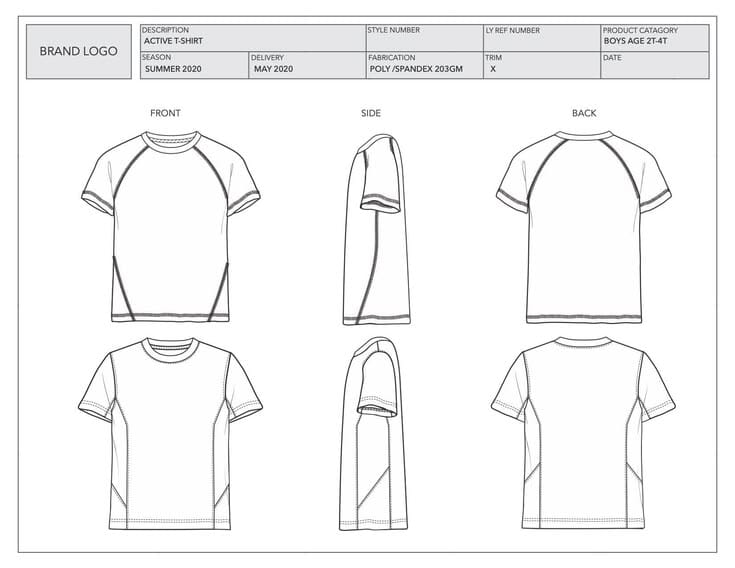
Double-needle topstitching is the streetwear tell. Two parallel rows of stitching on hems, cuffs and armholes read as sturdy and considered, and they hold up to the wash better than a single needle. Spec the stitch gauge and whether you want it tonal or contrast. Topstitch color is a design choice, so name the thread.
Bartacks lock the stress points. These are dense, short zigzags at pocket corners, the base of a fly, or where a drawcord exits the hood. Tell the factory where each bartack goes and roughly how many, because a pocket that isn't bartacked is a pocket that rips on the first heavy phone.
Ribbing carries the hand-feel at cuffs, hem and collar. A 2x2 rib holds shape better than 1x1 and reads more premium. Spec the rib composition, usually cotton with a touch of elastane for recovery, plus the rib depth and how its color matches the body.
I've seen a great hoodie let down by a slack cuff that grew out after one wear, purely because the rib had no elastane and nobody specced recovery. It's a two-word fix on the bill of materials that founders skip because the sample looked fine on day one. The wash is where it shows.
Self-fabric details signal care. A self-fabric drawcord, a self-lined hood or a self-collar all use the body cloth instead of a bought trim, which keeps the look clean and tonal. Each one is still a construction line: say self-fabric, or the factory reaches for the cheapest stock cord in the drawer.
Construction detail is what makes heavyweight streetwear feel premium. Double-needle topstitch, bartacks at stress points and 2x2 ribbing with elastane each add build hours and durability. Specify stitch gauge, bartack placement and rib composition, or the factory defaults to the fastest, lowest-cost finish on every seam.
What labels and hangtags does streetwear lean on?
Branding is where streetwear signals quality, so it belongs in the tech pack, not in a side email. Sewport groups labels among the bill-of-materials components a garment carries, alongside fabric, trims and prints (Sewport, 2023). Woven main labels, care labels, size tabs, hangtags and custom drawcords all need a line, a placement and a material.
Streetwear leans hard on trims because they're visible and easy to feel. A woven neck label, a printed care label, a rubber patch, metal drawcord tips: each reads as "considered." But each also costs money and lead time. Spec them early, in the bill of materials, so the price is in your quote from the start. Add them after sampling and they blow the budget.
Placement counts as much as the item. A neck label sewn 2 cm below the collar seam looks intentional. The same label sewn wherever the operator chooses looks cheap. Give a measured placement for every label and tag, the same way you would for a print. The factory follows the number.
Streetwear branding runs on more than a woven label. A heat-transfer neck print, the tagless option, swaps the itchy sewn label for a soft printed one that suits a clean inside neck. A woven main label reads more structured and premium. A printed care label carries fiber content and wash symbols by law, so it's never optional. Each is a separate bill-of-materials line with its own placement and material.
The small hardware trims are where streetwear signals spend. Custom drawcord tips, metal or injection-molded, custom zip pulls, rubber or woven patches, and a size flag stitched into the hem all read as intentional. They also carry the longest lead times and the highest per-unit cost, so they belong in the first quote, not a late change after the sample lands.
| Trim | Spec it with | Streetwear note |
|---|---|---|
| Woven main label | Placement, size, fold type, color | Reads premium, central inside neck |
| Heat-transfer neck (tagless) | Artwork, size, cure temp, placement | Soft inside neck, needs the right fabric |
| Printed care label | Fiber content, wash symbols, placement | Legally required on every garment |
| Hangtag | Material, print, string vs pin | First physical touchpoint |
| Custom drawcord tip | Material, finish, cord diameter | Long lead time, order early |
| Custom zip pull | Material, finish, logo, zip size | Adds hardware cost |
| Rubber or woven patch | Size, placement, attach method | Reads considered and durable |
Streetwear branding lives in the bill of materials, where labels sit alongside fabric, trims and prints. Spec woven labels, care labels, hangtags and drawcord tips early, with measured placements, so cost and lead time appear in the first quote rather than after the sample.
If you'd rather hand this off, our tech pack service builds a full production-ready spec, all eight sections, from $299. It's built for founders who'd rather spend their time on the next drop than on measurement tables.
What's in the core streetwear garment set?
The core streetwear set is four garments: the hoodie, the tee, the sweatpants and the jacket. Each is a different construction problem, and each needs its own tech pack built on the same eight sections (Techpacker, 2023). A hoodie spec won't work for sweatpants. The seams, trims and points of measure are different.

Start with the piece that defines your brand and build out. Most streetwear founders lead with the hoodie, so we wrote a dedicated hoodie tech pack guide covering fleece weight, hood construction and cuff ribbing. The t-shirt tech pack guide handles the volume seller, where GSM and neckline hold the quality. For bottoms, the sweatpants tech pack guide covers rise, cuff and drawcord. And the jacket tech pack guide deals with the hardest one: zips, linings and structured panels.
A streetwear brand's core set is the hoodie, tee, sweatpants and jacket, and each needs its own tech pack built on the same eight-section structure. Construction differs sharply between them: a jacket's zips and linings share almost nothing with a tee's neckline and hem.
What MOQ reality do indie streetwear brands face?
Small runs punish mistakes. Streetwear moves in drops of roughly 50 to 300 units per style, and at that scale a rejected sample or a re-cut can wipe the whole margin. Guru puts a tech pack at 5 to 20 hours of work per style (Guru, 2022), a rounding error next to the cost of a failed production run. The spec is your drop insurance.
Minimum order quantities stack up in ways first-timers miss. A cut-and-sew factory sets an MOQ per style, then often per color and per size too, so a four-color drop can carry four separate minimums. Fabric mills usually demand a higher minimum than the factory does, which is why heavy custom fleece is harder to get in small runs than a stock jersey. Knowing this before you design keeps the drop buildable.
The tech pack is what makes a small run repeatable. When a hoodie sells out and you reorder, the spec and the revision history are what keep the second batch matching the first. Without them, your restock comes back a different weight, a different black, a slightly different fit, and customers notice.
For an indie brand, consistency across drops is the brand. The tech pack is the only thing that guarantees it, because it turns your first good sample into a fixed reference every future batch is measured against. A brand that can't reproduce its own hoodie has a product, not a label.
A tight spec also gets you a real quote. Factories price risk, so a vague brief comes back padded or gets declined. A complete tech pack, with fabric, GSM, prints, trims and points of measure filled in, lets a factory quote accurately and lets you compare quotes fairly across suppliers. That alone often saves more than the pack costs to build.
Indie streetwear runs small, often 50 to 300 units per style, which leaves no cushion for a bad sample. Guru puts a tech pack at 5 to 20 hours per style (Guru, 2022), far below the cost of a rejected run. A complete spec, plus revision history, keeps reorders matching the first drop.
How do you inspect a streetwear sample before the full run?
Your last defence before a bad drop is sample inspection, and it runs on a sampling standard, not a gut feeling. QIMA reports that AQL 2.5 is the most common acceptance level, with 1.0 used for higher-risk goods and 4.0 for minor cosmetic defects (QIMA). Critical defects are allowed zero. This is the language factories already speak.
AQL, the acceptable quality limit, sets how many defects a batch can carry before it's rejected. The sampling math comes from ISO 2859-1, mirrored by ANSI/ASQ Z1.4, which tells an inspector how many units to pull and how many faults tip the batch into failure. For streetwear, misplaced prints, uneven puff and puckered embroidery are the defects that pile up. A tight tech pack gives the inspector a clear pass/fail line.
Sample inspection uses AQL levels defined against ISO 2859-1 and ANSI/ASQ Z1.4. QIMA notes AQL 2.5 as the most common level, 1.0 for higher-risk goods, 4.0 for minor cosmetic defects, and zero tolerance for critical defects (QIMA). A precise tech pack gives inspectors the pass/fail line to apply.
Start with the measurement page
Here's the whole guide in one line: spend less time on your graphic and more on your points of measure. The factory builds from numbers, not artwork. Get the eight sections down, spec each print method to its artwork, define your oversized block properly, and put every label and trim in the bill of materials from day one. Then use AQL to check the sample against the spec before the run.
Ready to build? Grab the free tech pack template, then work through the per-garment guides for your hoodie, tee, sweatpants and jacket. Do the boring pages well, and your first drop comes back looking like what's in your head.
Peter Midea runs a network of 80 clothing factories in Portugal and has watched more garments get rejected on a production line than he'd like to admit.
Frequently asked questions
How much does a streetwear tech pack cost?
Costs vary with garment complexity and who builds it. Guru reports a range of roughly $500 to $2,000 per style, based on five to twenty hours of work (Guru, 2022). A basic tee sits low; a lined jacket sits high. Doing your first draft yourself, then paying for a review, keeps early spend down.
Do I really need a tech pack for a small drop?
Yes, and arguably more than a large brand does. Small drops give you no cushion to absorb a bad sample across the order. The tech pack removes guesswork before cutting. Techpacker's eight-section structure applies whether you're making 50 units or 5,000.
What print method should I choose for my graphic?
Match the method to the artwork. Screen print suits flat spot colors, DTG suits photographic detail, puff suits bold low-detail shapes, and embroidery suits premium logo work. Treat each as a distinct bill-of-materials line with its own specs. Each fails on the artwork type it wasn't built for.
How do I spec an oversized fit correctly?
Give full points of measure for every size, not one instruction like "baggy." An oversized fit is a defined block. ASTM D5585-21 covers misses sizes 00 to 20 as a grading reference (ASTM). Set deliberate grade rules so the oversized proportion holds evenly from your smallest size to your largest.
What is AQL and why does it matter for streetwear?
AQL, the acceptable quality limit, sets how many defects a production batch can carry before rejection. QIMA lists AQL 2.5 as most common, with critical defects allowed zero (QIMA). For streetwear, misplaced prints and puckered embroidery are the defects a tight spec helps inspectors catch.
What fabric weight should a streetwear hoodie be?
A premium streetwear hoodie usually sits at 380 to 450 GSM in heavy fleece, while a midweight hoodie runs 300 to 350 GSM. A crewneck in French terry sits lighter, around 250 to 320 GSM. Spec the GSM on the bill of materials, or the factory substitutes a thinner, cheaper cloth.
How does garment dye affect my colorway spec?
Garment dye is applied after sewing, so expect visible color variation batch to batch and some shrinkage. Spec an approved lab dip as your color standard, give a shrinkage tolerance, and state that your measurements are post-wash. Treat the variation as a feature, but define how much you'll accept.
What's the difference between puff and high-density print?
Puff ink expands under heat into a soft, rounded, foam-like texture that suits bold shapes and loses fine detail. High-density print builds ink into sharp, tall edges with crisp shoulders, holding fine shapes puff can't. Both are raised prints, so spec the raise height and keep the artwork bold.
We build the factory-ready spec a manufacturer can quote from without a single question: technical flats, bill of materials, graded points of measure with tolerances, colorways and construction notes. $299 per style, 3 to 5 working days, 2 to 3 revision rounds.
Get your tech pack — $299Start with the free templateWe don't take your production. The spec is yours to send to any factory, anywhere. Talk to us first if you're not sure what you need.
Sources
Every statistic and definition in this article traces to one of the following. Each is listed once here, and cited inline where it is used.
- Techpacker
- Sewport
- Portugal Clothing Factory
- QIMA
- ASTM International
- ASTM International
- Guru
- otextilpt.sirv.com
- images.pexels.com
Related guides
- Tech packs: the complete guide
- Hoodie tech pack
- T-shirt tech pack
- Sweatpants & shorts tech pack
- Denim & jeans tech pack
- Jacket tech pack
- Hat & cap tech pack