Contents
- What is a manufacturing specification?
- How does it differ from a design brief?
- What must a specification contain?
- Why do tolerances matter so much?
- How do you write the bill of materials?
- How do you present measurements?
- How do you know a specification is finished?
- What goes wrong most often?
- How does a good specification change the quo…
- How does a specification differ by garment t…
- What does a factory actually do with it?
- Working with GarmentSpec
- Frequently asked questions

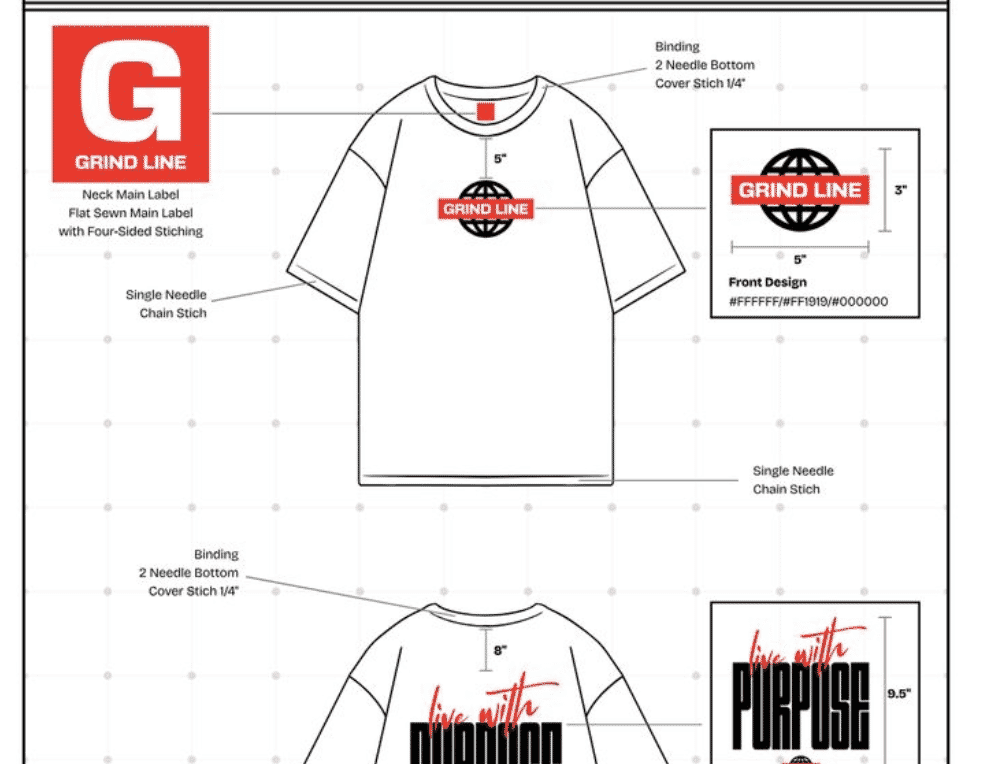
A manufacturing specification is the document that tells a factory exactly what to make and how. In apparel it is usually called a techpack, and its job is narrow and absolute: it has to remove every ambiguity between your intention and the garment that arrives. Any question it leaves open is answered by somebody on a production floor who has never met your customer.
This covers what a specification must contain, how it differs from a design brief, how to write each section, what a factory actually does with it, and how to tell whether yours is finished.
Key Takeaways
- A specification is judged by whether a stranger could produce the garment from it alone.
- Measurements without tolerances give a factory no standard and you no grounds to reject.
- The bill of materials is what stops trims halting a production run.
- Flats are how a factory counts operations, which is how it prices the garment.
- A design brief describes intent. A specification describes instruction.
What is a manufacturing specification?
The complete set of instructions a factory needs to produce a garment correctly without contacting you.
It is an instruction, not a description
A specification exists to be executed rather than interpreted, which is what separates it from every other document a brand produces. Every element in it is there because somebody standing on a production floor will otherwise have to make that decision themselves, and the document's entire purpose is to make each of those decisions in advance so that they are yours rather than theirs.
In apparel it is the techpack
The terms are used interchangeably: manufacturing specification, spec sheet, techpack and tech pack all describe the same package. What matters is not the label but whether it contains technical flats, a bill of materials, construction notes and graded measurements with tolerances.
It is also the basis of the price
Factories quote by counting operations and estimating material consumption, both of which come from the specification. An incomplete document produces a number that will change once the missing information appears, which is why quotes move on badly specified products.
It survives the relationship
A proper specification can be sent to a second factory, adapted for a new colourway or updated rather than rebuilt. It is the most portable asset a brand owns and the thing that makes changing supplier possible without restarting development.
How does it differ from a design brief?
A brief communicates intent to a designer. A specification communicates instruction to a factory.
Different reader, different content
A design brief describes the customer, the positioning, the mood and the intent, and it is the right tool for deciding what to make. A specification describes seam types, measurements and components, and it is the right tool for making it. Confusing the two produces a document useful to nobody.
Illustrations do not translate
A stylised drawing communicates attitude through exaggerated proportion, which is exactly what makes it unusable technically. A factory needs a proportional flat where a pocket sits where it will actually sit, and sending the former in place of the latter is the most common reason a first enquiry goes unanswered.
The specification comes second
Development moves from intent to instruction: concept, then fabric, then flats, then the full specification, then pattern. Attempting to write a specification before the fabric is settled produces measurements that will change, because drape determines how a garment has to be cut.
Both are needed
A brand with a specification and no clear product intent makes a garment nobody wanted precisely. A brand with intent and no specification cannot get it made. The documents serve different stages and neither replaces the other.
What must a specification contain?
Flats, a bill of materials, construction detail, graded measurements with tolerances, labelling and packing.
Technical flats
Proportional line drawings, front and back, showing every seam, dart, closure, pocket and topstitch line, with enlarged views of anything not obvious. Every construction line represents an operation somebody has to perform and count, so an omitted line is an omitted cost and an omitted instruction.
Bill of materials
Every component with a specification: shell fabric, lining, interlining, thread, zips, buttons, elastic, labels, hangtags and packaging. Include supplier and reference where you have them, because a component named generically will be substituted for whatever the factory can source.
Construction notes
Seam types at each position, stitch density, seam allowances, finishing at edges and hems. These determine whether the garment feels well made, and in their absence a factory applies its own house standard, which is a reasonable default and may not be what you were pricing against.
Graded measurements with tolerances
Every point of measure, at every size, with an acceptable range for each. This is the section that most often arrives incomplete and it is the one that determines whether a delivered garment can be accepted or rejected on any defensible basis.
Why do tolerances matter so much?
Because no production run hits a number exactly, and without a stated range nobody knows what passes.
Variation is normal, not a defect
Fabric relaxes after cutting, spreading introduces small differences and sewing adds its own variation, all of which is inherent rather than sloppy. A garment half a centimetre from the target measurement is not a fault unless you said in advance that it was, and a specification without tolerances implicitly treats every single unit as either exactly perfect or outright wrong.
They set the factory's target
A factory working to a tolerance knows what it is aiming for and can control its process against it. Without one it aims at the number, accepts whatever comes out and has no basis for rejecting its own work before it reaches you.
They decide disputes
A disagreement about whether a delivery is acceptable comes down to what was documented rather than to what either party considers reasonable. A brand without stated tolerances is arguing from preference, which is a weak position however justified it feels.
Different points deserve different ranges
A chest measurement matters considerably more than a pocket position, and a tolerance chart applying one identical range to every point has not thought about the garment at all. Set them tighter where the measurement is visible, structural or fit-critical, and looser where a small variation genuinely will not be noticed by anybody.
Short on time? We build the same spec as a service: technical flats, bill of materials, graded points of measure with tolerances. $299 per style, 3 to 5 working days.
How do you write the bill of materials?
Exhaustively, from the garment rather than from the costing sheet.
List from the physical object
Costing sheets group small items into a trims allowance; a garment has every component physically present and countable. Writing the list by examining the garment rather than the cost breakdown is what catches the thread, the interlining and the care label that nobody had listed.
Name the component, not the category
Button is a category; a four-hole 18-line corozo button in a specified colour is a component. Generic entries get filled with whatever the factory can source conveniently, and the substitution is usually only noticed once a sample arrives looking subtly cheaper than intended, at which point correcting it costs a revision round rather than a sentence.
Give every line an owner
Note who is supplying each item, you or the factory, line by line rather than as a general statement at the top. This single column changes a quote more than anything else in the entire document, and leaving it out is the most common ambiguity in a specification and the one that most reliably produces two quotes that cannot be compared.
Include quantities and placement
How many buttons, how much elastic, where each label sits and in what order stacked labels appear. Placement information belongs here as much as in the flats, because the person attaching it is working from this list.
How do you present measurements?
As a graded chart, with points of measure defined, tolerances stated and the measuring method unambiguous.
Define how each point is measured
Chest measured how, and from exactly where? A point of measure that two competent people would measure differently produces a disagreement that is genuinely nobody's fault and cannot be resolved by either side being more careful. Illustrating the method on the flat, or naming a standard convention the factory already uses, removes the ambiguity entirely for the cost of one diagram.
Grade rather than scale
Bodies do not change proportionally between sizes, so applying uniform increments across a range produces garments that fit at the sample size and badly at the extremes. Grading decisions belong in the specification rather than being left to a factory's default rules.
State whether measurements are pre or post wash
Fabric shrinks, and a chart that does not say which state it describes is ambiguous at the point it matters most. For anything that will be washed, give finished post-wash measurements and say so explicitly.
Keep the chart in one place
Measurements scattered across flats, notes and a separate document get out of sync the first time something changes. One authoritative chart, versioned, is what prevents a factory producing to a superseded number.
How do you know a specification is finished?
Give it to somebody who has never seen the product and cannot ask you a question.
The stranger test
If they could produce the garment you intended from the document alone, it is complete. If they would have to guess at anything, that guess will be made and it will not necessarily match what you had in mind.
Count the decisions you did not make
Walk the garment mentally from cutting to packing and ask what somebody would need to decide at each step. Every unanswered one is a decision you have transferred, and the ones most often transferred are seam finishes, label placement and packing.
Ask a factory to review it
An experienced factory will flag what cannot be sewn economically, what will not grade properly across a size range and what is simply missing, usually within a day and almost always at no charge. That review is by a wide margin the cheapest quality check available on a specification, and remarkably few brands ever think to request it before committing to a sample.
Expect one revision after the first sample
Even a complete specification gets refined once a physical garment exists. Treat the document as versioned rather than final, and make sure the factory is producing from the current version rather than the one they were sent first.
What goes wrong most often?
Missing tolerances, generic components, no supply column and an illustration in place of a flat.
Sending artwork instead of a flat
A stylised illustration cannot be quoted or produced, and sending one signals that the technical work has not been done. Factories triage by how serious an enquiry looks, and this is the clearest negative signal available.
Leaving tolerances blank
The most common omission and the one that causes the most disputes. A measurement chart without ranges cannot be produced to reliably or judged against fairly, which means both parties are exposed.
Describing rather than specifying
Notes like clean finish, quality stitching or premium feel are preferences rather than instructions. They cannot be executed, they cannot be checked, and they give the factory no more information than silence would.
Letting versions diverge
A change agreed in an email and never reflected in the document itself produces a factory working to one version while the brand expects another, and neither party knows until a sample or a run arrives wrong. Every change belongs in the specification, with a new version number and a date, before anybody treats it as agreed.
How does a good specification change the quote?
It makes the number accurate, comparable and stable.
Accuracy comes from countable operations
A factory prices by counting what it has to do. A complete flat and construction section lets it count precisely, which produces a number that holds rather than one that moves when reality arrives.
Comparability comes from identical briefs
Sending the same complete specification to several factories produces quotes for the same job. Sending each a slightly different version produces price differences that reflect your briefing rather than the factories, and the decision is then made on noise.
Stability protects both sides
A quote based on a complete document is one a factory can honour. One based on assumptions gets revised, and the revision always arrives at the least convenient moment, usually after the brand has committed to a retail price.
It affects how you are treated
A brand that supplies a complete specification is signalling that it will be straightforward to work with, and factories allocate attention accordingly. That is a real effect and it costs nothing beyond finishing the document.
How does a specification differ by garment type?
The sections are identical. Which section carries the risk changes completely.
Knits put the weight on measurements
In jersey and knit garments there is comparatively little construction to specify and the fit lives almost entirely in the measurement chart and the fabric. Tolerances matter more here than in wovens, because stretch masks variation until it does not, and a loose tolerance on a fitted knit garment produces sizes that overlap each other.
Wovens put the weight on construction
Shirts, jackets and tailoring carry their quality in seam types, interlining, pressing and stitch density, all of which are specification lines rather than measurement lines. A woven specification that details measurements thoroughly and leaves construction generic has documented the easier half.
Structured garments need the interlining named
Collars, cuffs and jacket fronts get their shape from interlining rather than from the shell, so leaving it as a category rather than a specification hands over the decision that most determines how the garment looks after a year. Name the type, the weight and whether it is fused or sewn in.
Technical product needs the performance stated
Where a garment claims water resistance, stretch recovery or moisture movement, the specification has to state the requirement rather than name a competitor's fabric. A supplier can respond to a performance requirement and cannot reproduce a cloth they have never handled.

What does a factory actually do with it?
Costs it, plans it, orders against it and inspects against it, which is why each section has a different reader.
Costing reads the flats and construction
The person pricing your garment counts operations from the flats and the construction notes and estimates fabric consumption from the pattern. Everything they cannot count they either assume or query, and an assumption made at costing stage becomes a price revision later.
Purchasing reads the bill of materials
A different person orders components entirely from that list, frequently without seeing the flats. If a trim is named generically there, it is bought generically, regardless of how precisely it is drawn elsewhere in the document.
The line reads the construction notes
Operators and supervisors work from construction detail and the sealed sample rather than from the full document. Notes that describe an outcome rather than a method do not survive this stage, because nobody on a line can act on a request for a clean finish.
Quality control reads the measurement chart
Inspection is performed against the points of measure and the tolerances, and nothing else. A garment that misses an unstated expectation passes inspection legitimately, which is why every standard you care about has to appear in that chart.
Working with GarmentSpec
We build production-ready specifications: technical flats, bill of materials, and graded points of measure with tolerances, in the format factories read before cutting.
$299 per style, 3 to 5 working days.
Frequently asked questions
What is a manufacturing specification in apparel?
The complete set of instructions a factory needs to produce a garment correctly without contacting you. In apparel it is usually called a techpack and contains flats, a bill of materials, construction notes and graded measurements with tolerances.
What is the difference between a specification and a design brief?
A brief communicates intent to a designer and describes customer, positioning and mood. A specification communicates instruction to a factory and describes seams, components and measurements. They serve different stages and neither replaces the other.
Why are measurement tolerances necessary?
Because no production run hits a number exactly. Without a stated range a factory has no target to control against and you have no defensible basis for accepting or rejecting a delivery.
What should a bill of materials include?
Every component with a specific description rather than a category, plus quantity, placement and a column stating whether you or the factory supplies it. That last column changes a quote more than anything else in the document.
Should measurements be pre-wash or post-wash?
For anything that will be laundered, give finished post-wash measurements and say so explicitly. A chart that does not state which it describes is ambiguous exactly where it matters most.
How do I know my specification is complete?
Give it to somebody who has never seen the product and cannot ask you a question. If they could make it correctly, it is finished. If they would have to guess, that guess will be made without you.
We build the factory-ready spec a manufacturer can quote from without a single question: technical flats, bill of materials, graded points of measure with tolerances, colorways and construction notes. $299 per style, 3 to 5 working days, 2 to 3 revision rounds.
Get your tech pack — $299Start with the free templateWe don't take your production. The spec is yours to send to any factory, anywhere. Talk to us first if you're not sure what you need.
Sources
- Techpacker, standard tech pack content sections
- QIMA, AQL inspection standards for apparel
GarmentSpec builds factory-ready tech packs: technical flats, bill of materials, and graded points of measure with tolerances. $299 per style, 3 to 5 working days.